Catalogue
Symbols
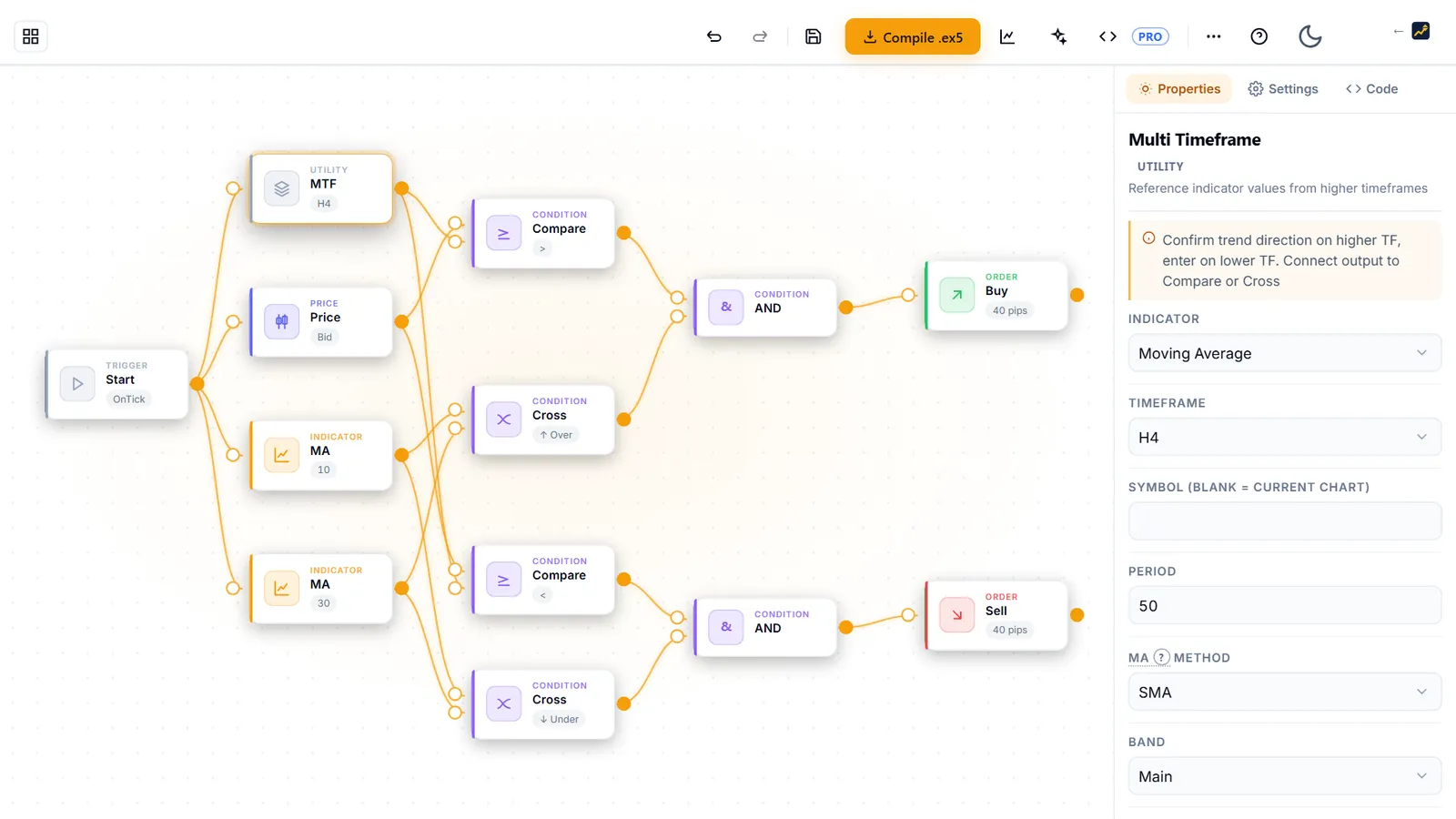
Each symbol page documents typical spread, volatility profile, best sessions, and which strategies tend to fit — the groundwork for designing and backtesting your own EA on that symbol in EA Builder.
- 28 symbols
- 5 asset classes
- Last reviewed: 2026-09-27 · AIStrategyMiner Editorial Team
Five asset classes, five kinds of behaviour
Pick the class first. It tells you what moves the price, when it is active and how large the risk per pip is.
- 01
Forex
Currency pairs. Each pair is most active while the markets of its two currencies are open.
14 symbols ↓ - 02
Metals
Gold and silver trade like macro assets, not currencies: larger ranges and a bigger risk per pip.
2 symbols ↓ - 03
Energy
Crude oil. Supply news and inventory reports create sharp moves, so stops and sessions need care.
2 symbols ↓ - 04
Stock indices
Stock indices follow a country's equity market and wake up with its cash session.
6 symbols ↓ - 05
Crypto
Crypto trades around the clock and holds the most extreme volatility profiles in this library.
4 symbols ↓
Forex
Currency pairs. Each pair is most active while the markets of its two currencies are open.
-
EUR/USD
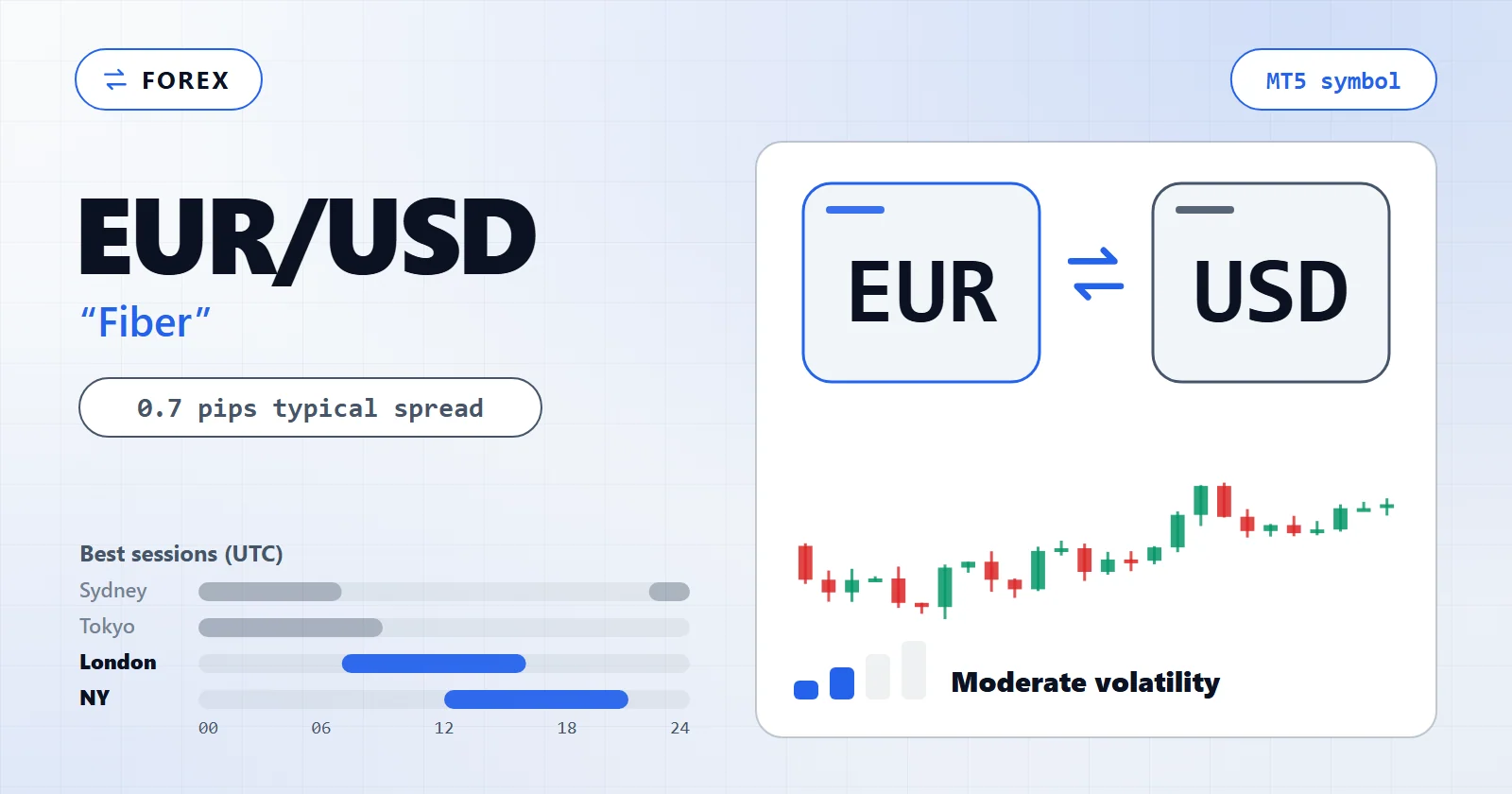
FiberThe most liquid forex pair globally. Tight spreads, deep order books, and clear technical structure make it the default surface for systematic strategies — and the first market to hold any EA claim against real tick data.
Moderate volatility 0.7 pips spread -
GBP/USD
CableCable — the high-volatility major. BoE policy cycles and UK-specific risk drive sustained directional moves that reward London-session trend and breakout EAs, and punish scalpers in the thin overnight hours. Wider and faster than EUR/USD, so the stop math and the account type matter more.
High volatility 1.5 pips spread -
USD/JPY
GopherThe primary USD/Asia major and the archetypal carry pair. A live Tokyo session, BoJ intervention history near 145–152, and reliable liquidity make it a natural surface for trend, carry and news EAs — but the intervention tail can reverse a long by hundreds of pips in minutes.
Moderate volatility 0.8 pips spread -
AUD/USD
AussieThe commodity major and a reliable risk barometer. Iron ore, coal and Chinese demand cycles drive multi-week trends, and a live Sydney session gives 24-hour trend EAs signal that EUR/USD lacks. In risk-off events it falls with equities, so a risk filter matters more than on a pure USD major.
Moderate volatility 1.0 pips spread -
NZD/USD
KiwiThe commodity major's smaller sibling — a dairy-and-risk barometer with a ~0.85 correlation to AUD/USD that turns an AUD+NZD basket into one leveraged bet. A live Wellington/Sydney open gives Asia-Pacific EAs signal, but thinner liquidity means wider relative spreads and a real Monday-open gap risk.
Moderate volatility 1.3 pips spread -
EUR/CHF
Euro-SwissA low-volatility major cross and one of the cleanest mean-reversion surfaces in FX. Tight EU–Swiss economic integration and SNB intervention history create implicit range boundaries — ideal for Bollinger and grid EAs, and a poor fit for anything that needs a large trend. The 2015 peg break is the standing tail-risk warning.
Low volatility 1.1 pips spread -
USD/CAD
LoonieThe oil major — the one pair that trades its commodity as much as its calendar. USD/CAD moves inversely to WTI crude, so an oil shock can override BoC and Fed policy in an hour. A strong NY session and wide standard spread make it a news-and-trend surface that punishes any EA blind to the crude tape.
Moderate volatility 1.6 pips spread -
GBP/JPY
DragonThe most volatile G10 cross — daily ranges of 120–180 pips when GBP and JPY catalysts land together. High per-trade return and high drawdown in one instrument. Suits aggressive trend and breakout EAs with wide ATR-scaled stops, and punishes anything sized for a European major.
Extreme volatility 2.0 pips spread -
EUR/JPY
YuppyThe most liquid JPY cross and a clean risk-on barometer. Two central-bank streams — ECB and BoJ — drive daily ranges wider than any European major, and the London–Tokyo overlap runs hottest. Its tight tracking of USD/JPY means a EUR/JPY + USD/JPY book is hidden double-exposure to the yen.
High volatility 1.6 pips spread -
USD/CHF
SwissieThe safe-haven inverse of EUR/USD, with a −0.85 to −0.95 correlation that makes a same-direction EUR/USD pairing a hidden double-position. In risk-off events CHF demand drives sharp drops even when the dollar is strong; in calm markets it oscillates in tight mean-reverting channels.
Moderate volatility 1.2 pips spread -
AUD/JPY
RioThe market's purest risk-on/risk-off proxy — a carry cross that tracks global equities so closely it trades like a leveraged S&P position dressed as a currency pair. A live Asia-Pacific session and twin RBA + BoJ catalysts make it a trend surface, but the risk-off cliff and carry unwind are its defining hazards.
High volatility 1.8 pips spread -
NZD/JPY
Kiwi-YenA high-yield carry cross and AUD/JPY's thinner, wider-spread cousin. The interest differential makes the long carry attractive and the risk-off unwind brutal; near-twin correlation with AUD/JPY means running both is one position. Its wider spread taxes anything that is not a patient trend or carry hold.
High volatility 2.3 pips spread -
EUR/GBP
ChunnelThe intra-European cross — a pure ECB-versus-BoE relative bet with a tight daily range that suits mean-reversion and frustrates trend. Its edge is that going long EUR/GBP is close to long EUR/USD and short GBP/USD at once, so it is both a clean single-trade expression of divergence and a hidden correlation trap.
Low volatility 1.3 pips spread -
GBP/CAD
BarnieA double-major cross that stacks GBP's policy volatility on CAD's oil sensitivity — two independent drivers on two different calendars in one wide-spread instrument. The range rewards patient trend and breakout EAs; the 3–5 pip standard spread and thin liquidity punish everything faster.
High volatility 3.5 pips spread
Metals
Gold and silver trade like macro assets, not currencies: larger ranges and a bigger risk per pip.
-
XAU/USD
GoldSpot gold versus the US dollar — a macro asset, not a currency pair. Real rates, USD strength and geopolitical premia drive multi-month trends that dwarf FX. A large ATR and $100/pip standard sizing mean gold needs proportionally larger stops and 2–3× the capital of a major.
High volatility 2.5 pips spread -
XAG/USD
SilverGold's high-beta cousin — spot silver moves further and faster than gold, with a dual monetary-and-industrial demand base and a wider spread. The gold/silver ratio, extreme intraday whips and a tick convention that differs from forex make sizing, not indicator choice, the thing that decides a silver EA's survival.
Extreme volatility 3.0 pips spread
Energy
Crude oil. Supply news and inventory reports create sharp moves, so stops and sessions need care.
-
WTI Oil
WTIWest Texas Intermediate crude — the US oil benchmark, driven by weekly inventory data, OPEC decisions and geopolitics rather than an FX calendar. Front-month CFDs roll and can gap on expiry, and its 2020 dip below zero is the standing reminder that oil has tail risks a currency never does.
High volatility -
Brent Oil
BrentBrent crude — the global seaborne oil benchmark that prices more of the world's supply than WTI and carries a larger geopolitical premium. It trades on OPEC, global demand and supply shocks, rolls like any front-month CFD, and its spread to WTI is itself a widely-watched signal.
High volatility
Stock indices
Stock indices follow a country's equity market and wake up with its cash session.
-
US500
The S&PThe S&P 500 CFD — the world's benchmark equity index and the default risk-on gauge. A long-run upward drift rewards trend EAs, but overnight cash-session gaps, index-level leverage and a tight cluster of mega-cap weightings mean a stock-index EA fails in ways a forex system never sees.
Moderate volatility -
NAS100
The NasThe Nasdaq 100 CFD — the high-beta tech index that moves further and faster than the S&P. Long-duration tech makes it acutely rate-sensitive, and a heavy mega-cap concentration means a single earnings miss can swing the whole index. Big ranges reward trend and breakout EAs that are sized for the volatility.
High volatility -
US30
The DowThe Dow Jones 30 CFD — a price-weighted blue-chip index where the highest-priced stocks, not the biggest companies, move the tape. That quirk plus a large per-point value makes it behave differently from the cap-weighted S&P, and rewards trend EAs that understand what is actually driving it.
Moderate volatility -
GER40
The DAXThe DAX 40 CFD — Europe's most-traded index and a total-return benchmark that includes reinvested dividends, unlike most price indices. It takes a strong lead from the US open, so a DAX EA that ignores Wall Street is trading half the picture. Clean European-session ranges reward trend and breakout systems.
High volatility -
JP225
The NikkeiThe Nikkei 225 CFD — Japan's blue-chip index and, in practice, a leveraged bet on a weak yen: it rises when the yen falls, so a JP225 EA that ignores USD/JPY is missing its main driver. Price-weighted like the Dow, it gaps on the Tokyo open after overnight US-tech moves.
High volatility -
UK100
The FootsieThe FTSE 100 CFD — a globally-earning, energy-and-miner-heavy index with a quirk that catches EAs out: it often rises when the pound falls, because its constituents earn in foreign currency. Lower volatility than the DAX and a commodity tilt make it a different animal from the US indices.
Moderate volatility
Crypto
Crypto trades around the clock and holds the most extreme volatility profiles in this library.
-
BTC/USD
BitcoinBitcoin against the dollar — a 24/7 macro-liquidity asset that trades through weekends when forex is closed, and increasingly moves with tech-risk sentiment. Extreme volatility rewards trend and breakout EAs but demands volatility-scaled sizing; the CFD's financing and weekend-gap risk are unlike anything in forex.
Extreme volatility -
ETH/USD
EtherEthereum against the dollar — Bitcoin's higher-beta counterpart, a 24/7 asset that moves with BTC but swings harder and adds its own network-event catalysts. Running ETH alongside BTC is close to one leveraged crypto bet. Extreme ranges reward trend EAs sized for the volatility and the CFD financing.
Extreme volatility -
XRP/USD
RippleXRP against the dollar — a low-nominal-price, headline-driven crypto where regulatory and legal news moves the price in binary jumps. Thinner liquidity than BTC or ETH means wider slippage, and the low unit price makes lot-value easy to misjudge. A 24/7 asset for event-aware trend EAs only.
Extreme volatility -
SOL/USD
SolanaSolana against the dollar — the highest-beta major crypto, moving more than BTC or ETH in both directions, with a network-reliability tail risk from its history of outages. A 24/7 asset that follows the ETH/BTC risk tone while adding its own protocol-specific shocks. For trend EAs sized for the extremes.
Extreme volatility
Frequently asked questions
- What is a symbol in MetaTrader 5?
- A symbol is a single tradable instrument — EUR/USD, gold (XAU/USD), the US500 index, Bitcoin, and so on. Each symbol carries its own spread, contract size, trading hours, and volatility, which is why an EA tuned for one can behave very differently on another.
- Which symbol is best for automated trading?
- There is no universal best — it depends on your strategy. Tight-spread majors like EUR/USD suit high-frequency and scalping systems, gold and indices offer bigger ranges for breakout EAs, and crypto trades around the clock but with wider swings. Match the symbol's volatility and session to what your EA is built to exploit.
- Do EAs work on gold, indices and crypto too?
- Yes. An Expert Advisor trades any symbol your broker offers, not just forex. The logic is the same; only the numbers change — spread, tick value, and volatility — so always re-backtest and re-optimise an EA on the specific symbol before running it live.
- How do I choose a symbol for my strategy?
- Start from what your strategy needs. Mean-reversion wants a ranging, tighter-spread pair; breakout and trend systems want the wider daily range of gold or an index; news systems want liquid majors. Each symbol page here lists the typical spread, volatility profile and best sessions so you can match it to your EA — then confirm in a backtest.
Test an idea on any of these symbols
Pick a symbol, build the entry and exit rules from blocks in the AIStrategyMiner Builder, then test them on your own price history before you decide anything.
- Compile a standard .ex5 file for MetaTrader 5 and check it in the Strategy Tester.
Test any EA in the MetaTrader 5 Strategy Tester before you rely on it. Past results do not predict future ones.