EUR/JPY — “Yuppy” — is the most liquid of the yen crosses and the one pair where two independent central-bank stories, the ECB’s and the BoJ’s, compound inside a single price. That gives it a wider daily range than any European major and a distinctly two-sided character. It is a risk-on barometer that trends when sentiment is clear and knifes both ways when it is not. The first question is whether your strategy wants that double-catalyst range or merely tolerates it — a EUR/USD system ported over unchanged almost always finds it too tight to survive here.
This page covers what EUR/JPY gives an automated strategy that a European major does not, the sessions that decide its results, and what it costs to trade. It then covers the failure modes that catch systems moved over from calmer pairs, and how to build and test a EUR/JPY EA of your own.
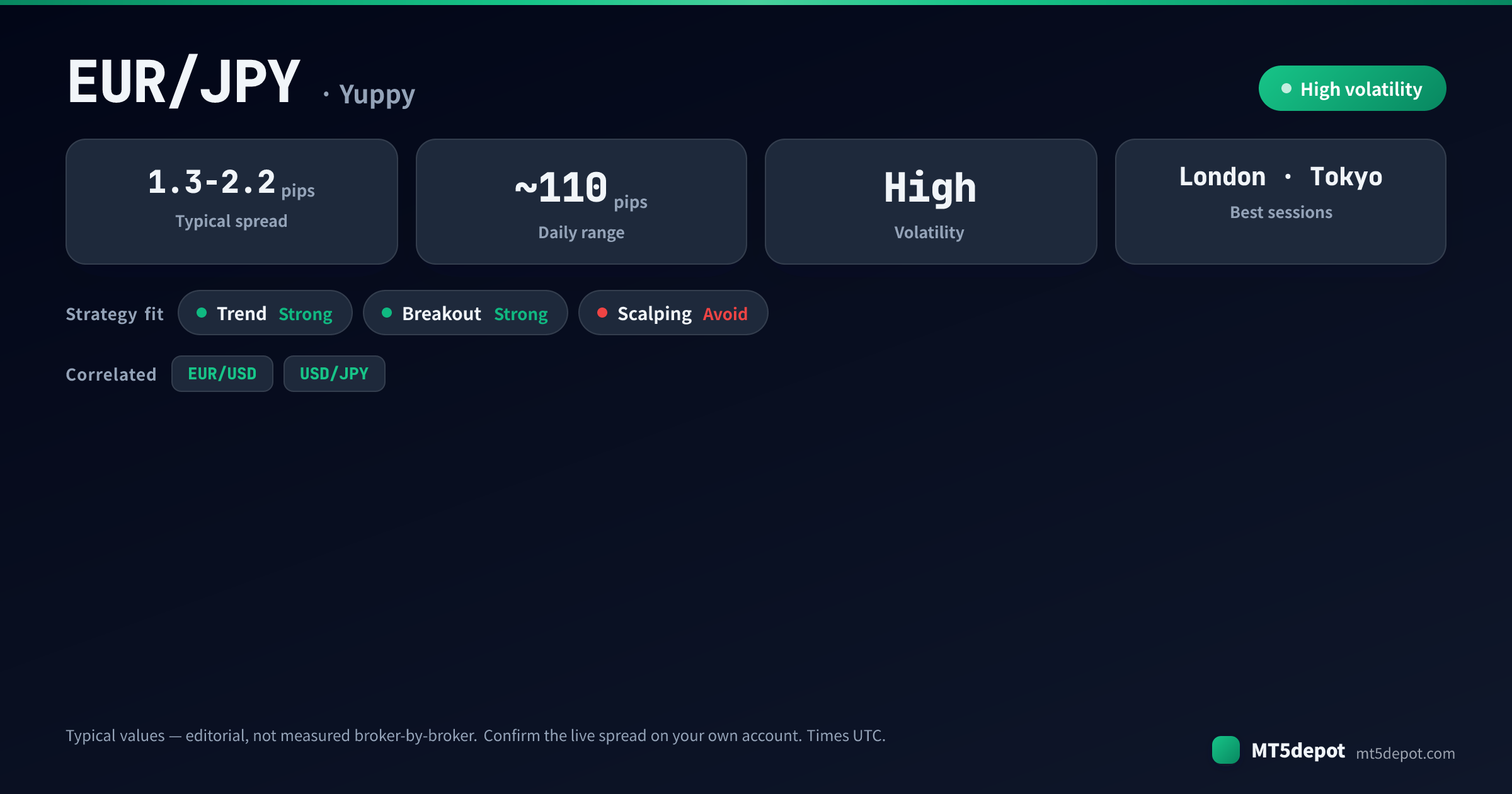
How EUR/JPY Behaves: What Yuppy Gives an EA
EUR/JPY is a cross, not a dollar pair, and that changes everything about how it moves. There is no shared USD baseline holding it steady — instead it carries two independent central-bank streams at once, and each one drives it on its own schedule.
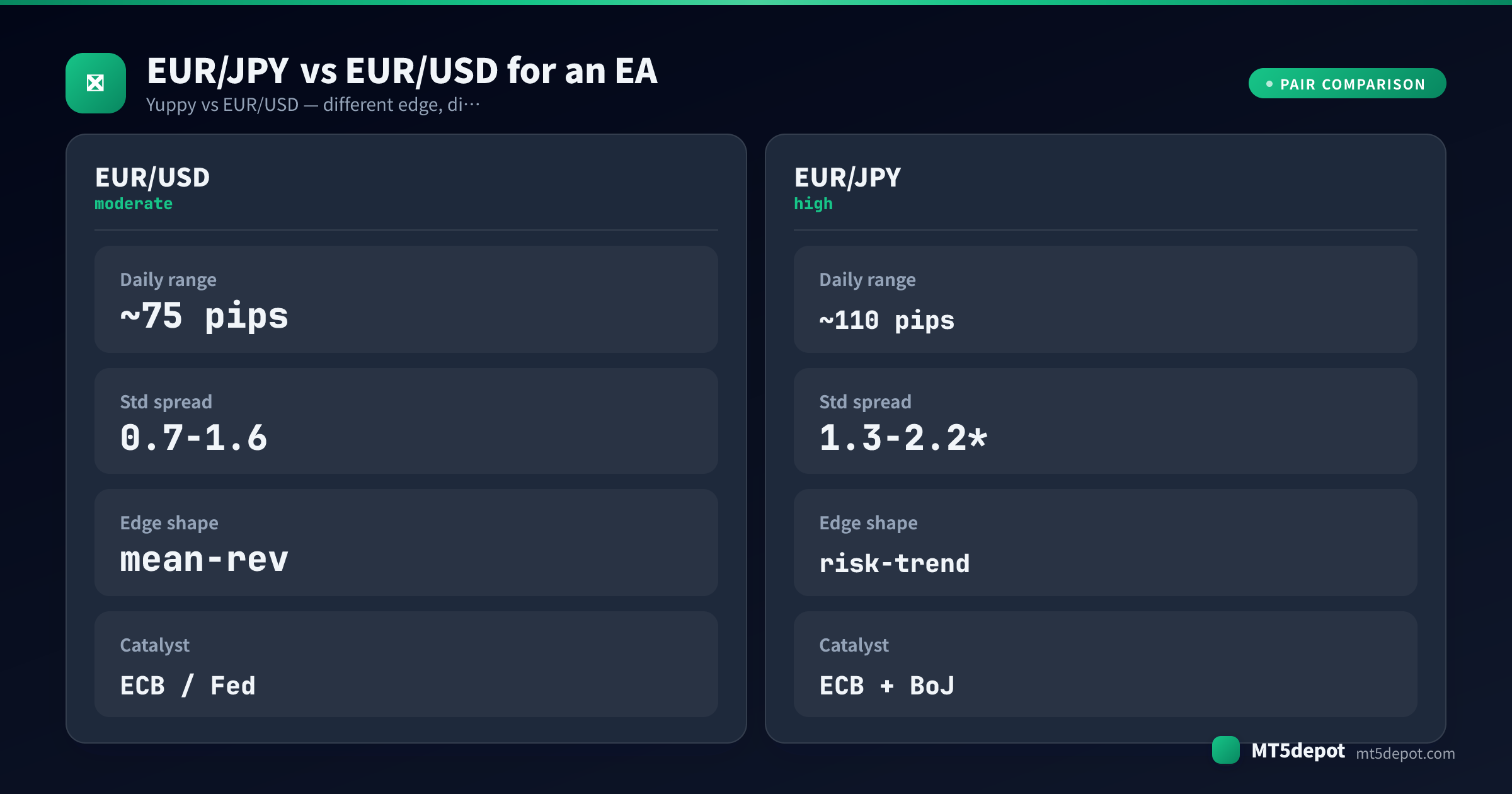
For an EA, that character reduces to three properties:
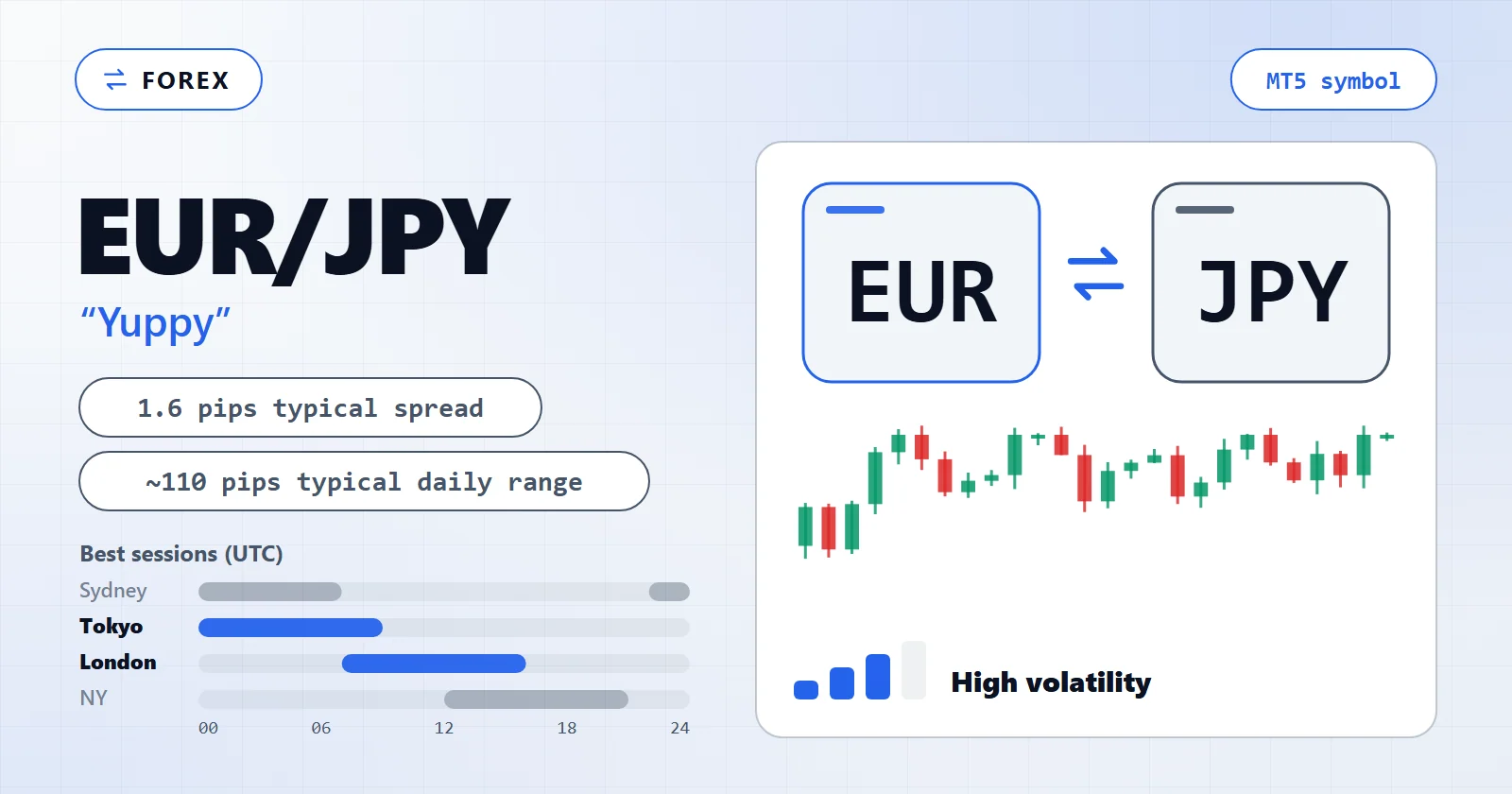
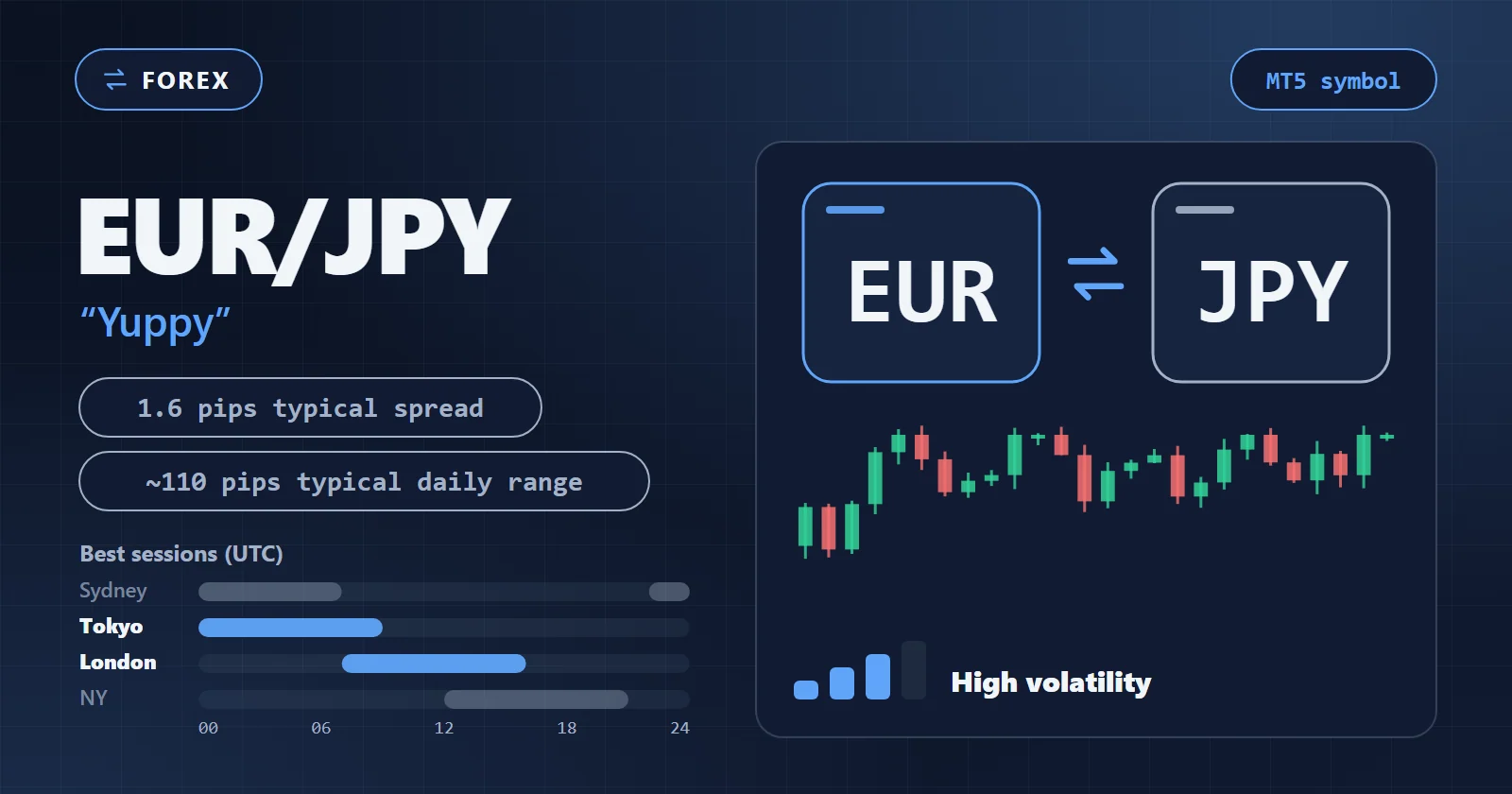
- A wider range than any European major. Our published typical daily range is near 110 pips — labelled typical, not measured broker-by-broker. It tends to run wider than EUR/USD’s for one structural reason. Two central banks, the ECB on the EUR leg and the BoJ on the JPY leg, can each move it, and when their stories point the same way the moves compound. That extra range is the single fact the rest of this page follows from.
- A tight yen-cross correlation. EUR/JPY tracks USD/JPY closely, because both share the yen leg. In practice that means much of a EUR/JPY move is a yen move dressed up as a euro move. That fact quietly turns a “EUR/JPY plus USD/JPY” book into a doubled bet on the same currency rather than two separate positions.
- A risk-on/risk-off tell. As the most liquid JPY cross, Yuppy behaves like a sentiment barometer: it grinds higher on carry demand when equities are calm and drops hard when they crash, as risk-off flow buys the yen. That gives trend systems a clean surface in stable regimes and a cliff in unstable ones.
The trap for automated strategies is the twin-catalyst range itself. What looks like edge on a backtest is also what widens spreads and gaps prices when the ECB and BoJ land near each other. Those are the moments an EA tends to concentrate its trades. Yuppy rewards systems that respect its volatility and quietly drains ones that assume a European-major-shaped range.
Which EA Strategies Suit EUR/JPY?
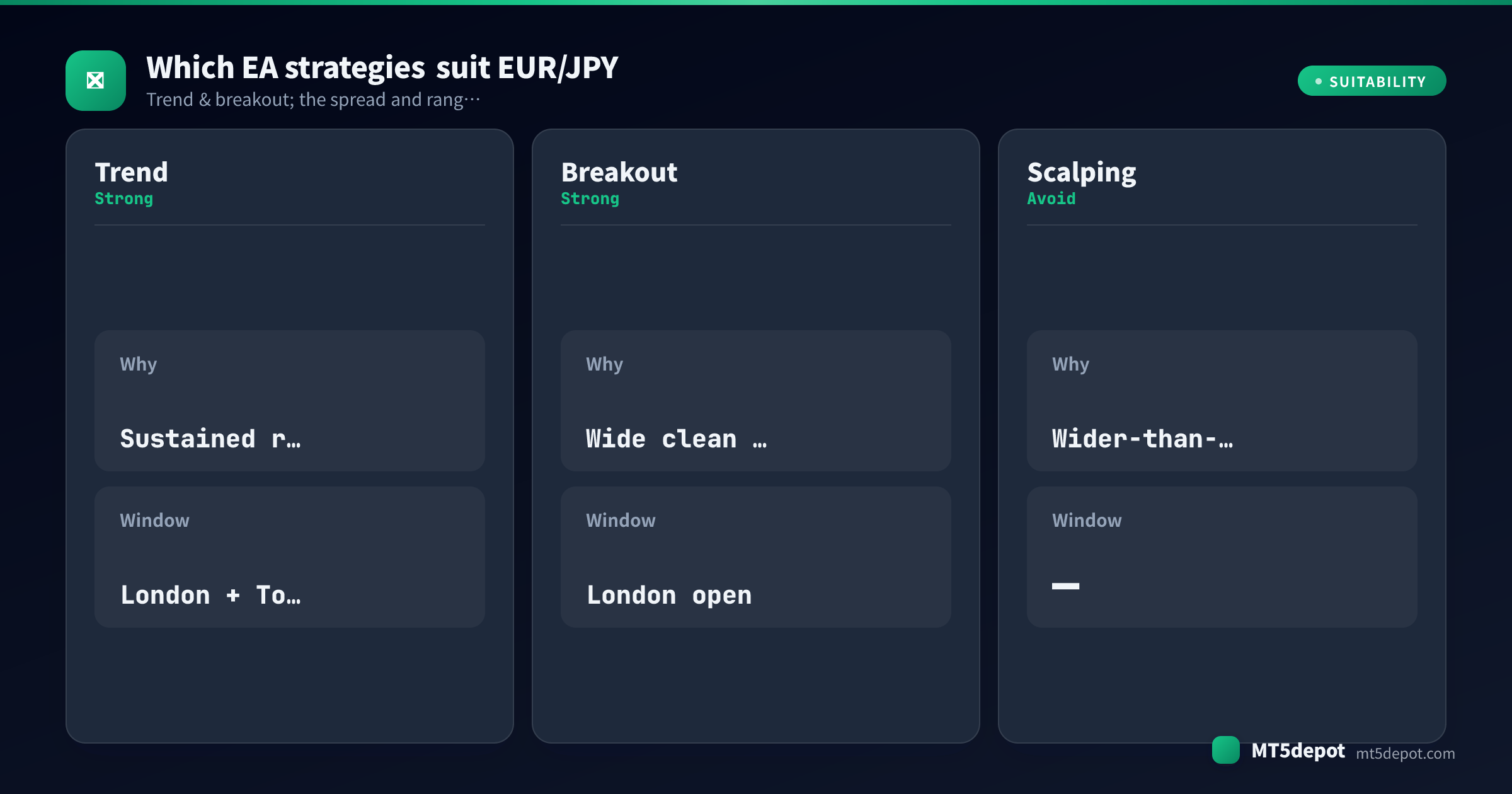
The pair’s profile lists trend and breakout as suitable — but suitability is not proof. In our own stock-settings baseline of the Builder’s templates — a single USD/JPY M5 run over one year, default inputs, no optimisation — most finished below a 1.0 profit factor, and that run was not on EUR/JPY. Almost none cleared the Builder’s own bar at stock settings, so treat any edge on EUR/JPY as something your own settings and test have to earn. Look for it in mechanics — pending stop orders, session windows, ATR-scaled stops — not the indicator on the box. What EUR/JPY’s character supports specifically:
| Strategy | Fit on EUR/JPY | Why |
|---|---|---|
| Trend-following | Strong | Sustained risk-on and risk-off moves give trend systems a clean directional surface. The London and Tokyo windows are where the flow is two-sided. |
| Breakout (pending orders) | Strong | The pair produces wide, clean ranges that resolve on the London open. Pending-order entries at the range edge are less spread-sensitive than market fills — which matters more on a wider-spread cross than on EUR/USD. |
| Scalping | Avoid | The 1.3–2.2 pip standard spread and the pair’s fast excursions make the cost math hostile; small-move strategies pay a wider-than-major spread on every trade. |
| Multi-symbol basket | Handle with care | EUR/JPY is available as a Builder leg. But its tight USD/JPY correlation means a “diversified” basket that also holds USD/JPY is closer to one leveraged yen position — a risk covered below. |
Trend and breakout are the shapes that turn EUR/JPY’s range into an asset; scalping has to fight a spread that a major would not charge. The practical route is to build one of these shapes yourself. The Builder ships trend and breakout templates that accept EUR/JPY and expose every parameter. Test it (below) before you trust a single number.
Best Trading Hours for EUR/JPY EAs
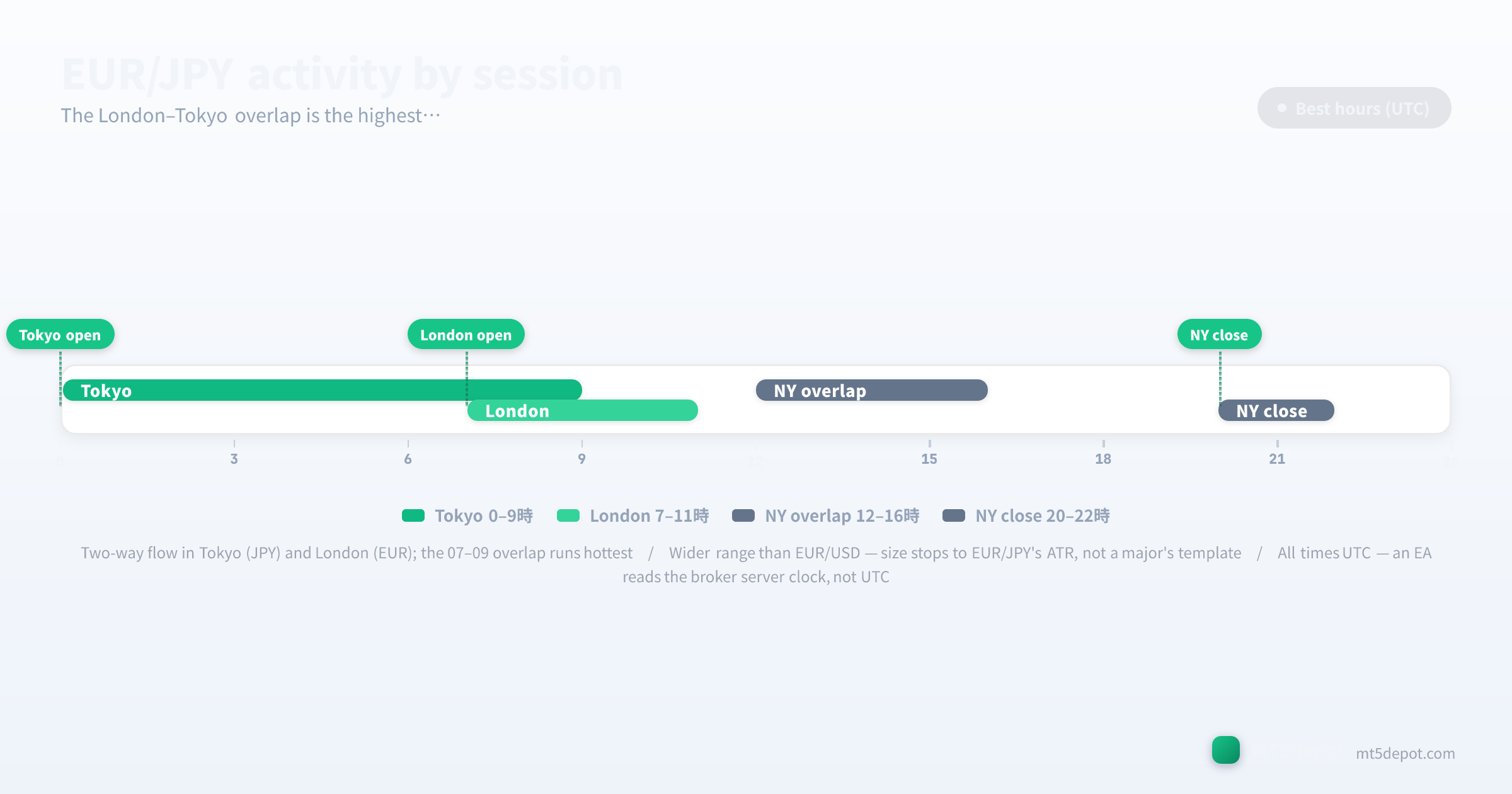
EUR/JPY is unusual among the pairs on this site. Both of its legs have a home session, so activity is genuinely two-sided rather than concentrated in one window:
- Tokyo session (00:00–09:00 UTC): the JPY leg is live and local flow moves the yen, but with Europe still asleep the range is often one-sided and prone to a false consolidation that resolves later. Trend EAs reading H1 signals here can pick up moves that reverse at the London open.
- London–Tokyo overlap (07:00–09:00 UTC): in our editorial assessment this is the hottest window of the day for Yuppy. These are the only two hours when both central-bank constituencies are trading at once, so the EUR and JPY legs push together and the range expands fastest. Breakout and trend EAs tend to earn most of their result here.
- London session (07:00–16:00 UTC): the EUR leg’s primary window; European data and ECB-linked flow drive the directional moves after the overlap fades.
- Late US hours (20:00–22:00 UTC): liquidity thins as both home sessions close, breakouts turn false, and session-quality filters should exclude these hours.
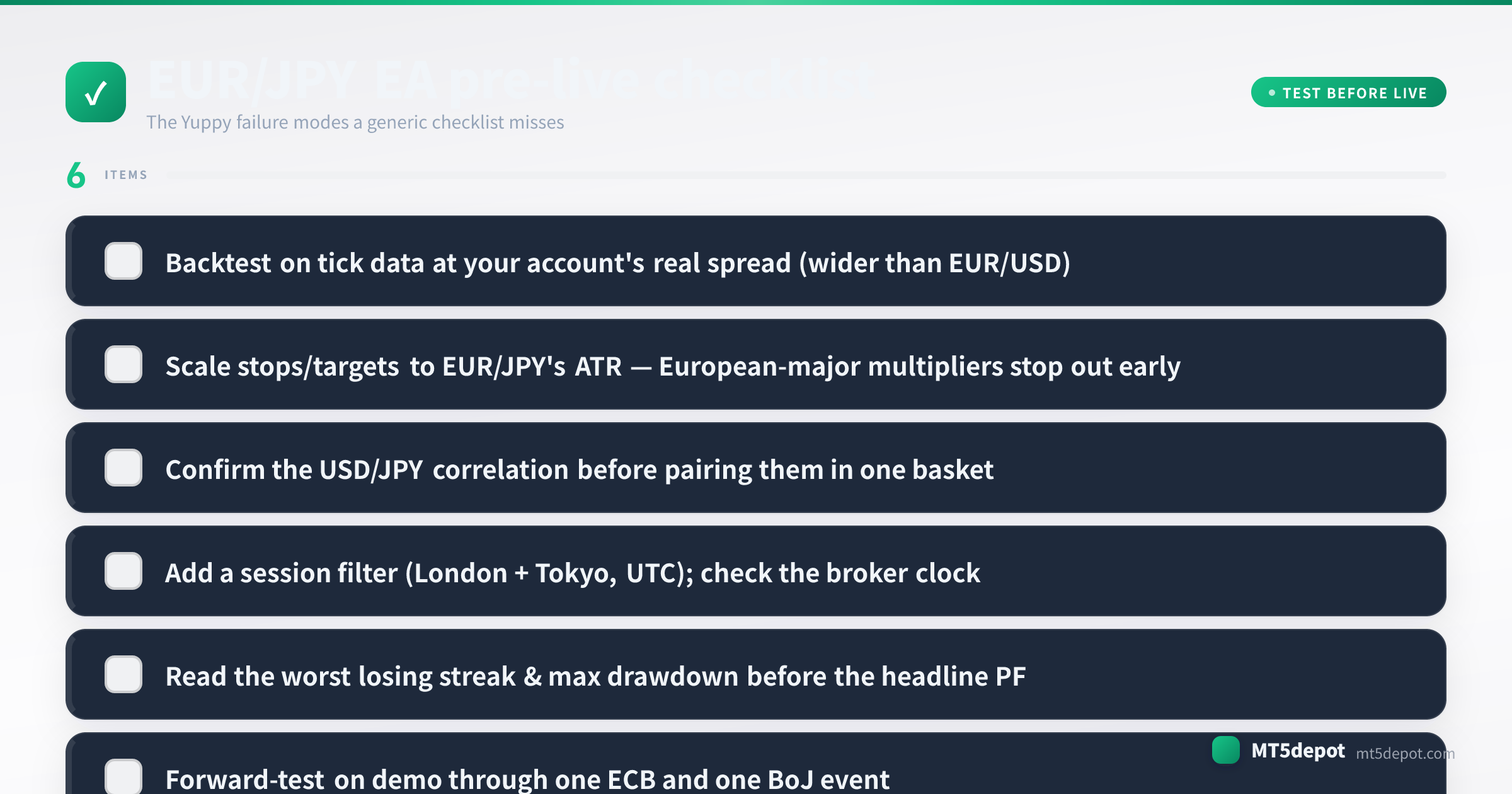
In our editorial assessment, EAs that restrict trading to the London and Tokyo windows — and especially the overlap — often out-perform 24-hour variants. A session filter is best treated as part of the strategy definition rather than an optimisation flourish. It is a hypothesis worth testing on your own data. One caution governs every time above. Each clock time here is UTC. But an EA reads your broker’s server clock, which is usually not UTC, so a “07:00” filter shifts silently when you move the EA between brokers on different server timezones. This is the one clock rule for the whole page. Verify it once in MT5’s Market Watch, and every session boundary lines up.
Spreads, Costs, and Execution
EUR/JPY is more expensive to trade than EUR/USD. The figures below are editorial reference ranges compiled from broker-published standard and raw conditions (updated July 2026), not broker-by-broker measured numbers; our live spread sampling currently covers EUR/USD and a few reference symbols. Confirm the live spread on your own account before you size a fast strategy:
| Account type | Typical EUR/JPY spread | Commission | Who it suits |
|---|---|---|---|
| Standard | 1.3 – 2.2 pips | none | swing / low-frequency trend and breakout EAs |
| Raw / ECN | 0.4 – 0.9 pips | $3 – 7 / lot | higher-frequency EAs that can absorb commission |
Two cost rules specific to this pair:
- Budget wider than a European major, and confirm on your own account. EUR/USD’s typical standard spread starts around 0.7 pips (a typical reference range, not a measured figure; confirm it on your own account). EUR/JPY’s standard spread typically runs wider, in the 1.3–2.2 range above. That extra width is a rounding error for a swing EA and a recurring tax for a fast one. Higher-frequency EUR/JPY systems therefore belong on raw-type accounts where the spread compresses to a known number.
- The commission is an account property, not a pair property. The same $3–7/lot raw commission applies whether you trade EUR/USD or EUR/JPY; what changes between pairs is the spread on top of it. There is one extra cost that is a pair property here. Because EUR/JPY is a yen cross, its overnight swap can be materially larger than a European major’s. Any strategy that holds positions overnight has to price the carry into the test rather than discover it live.
Risks to Test Before Going Live
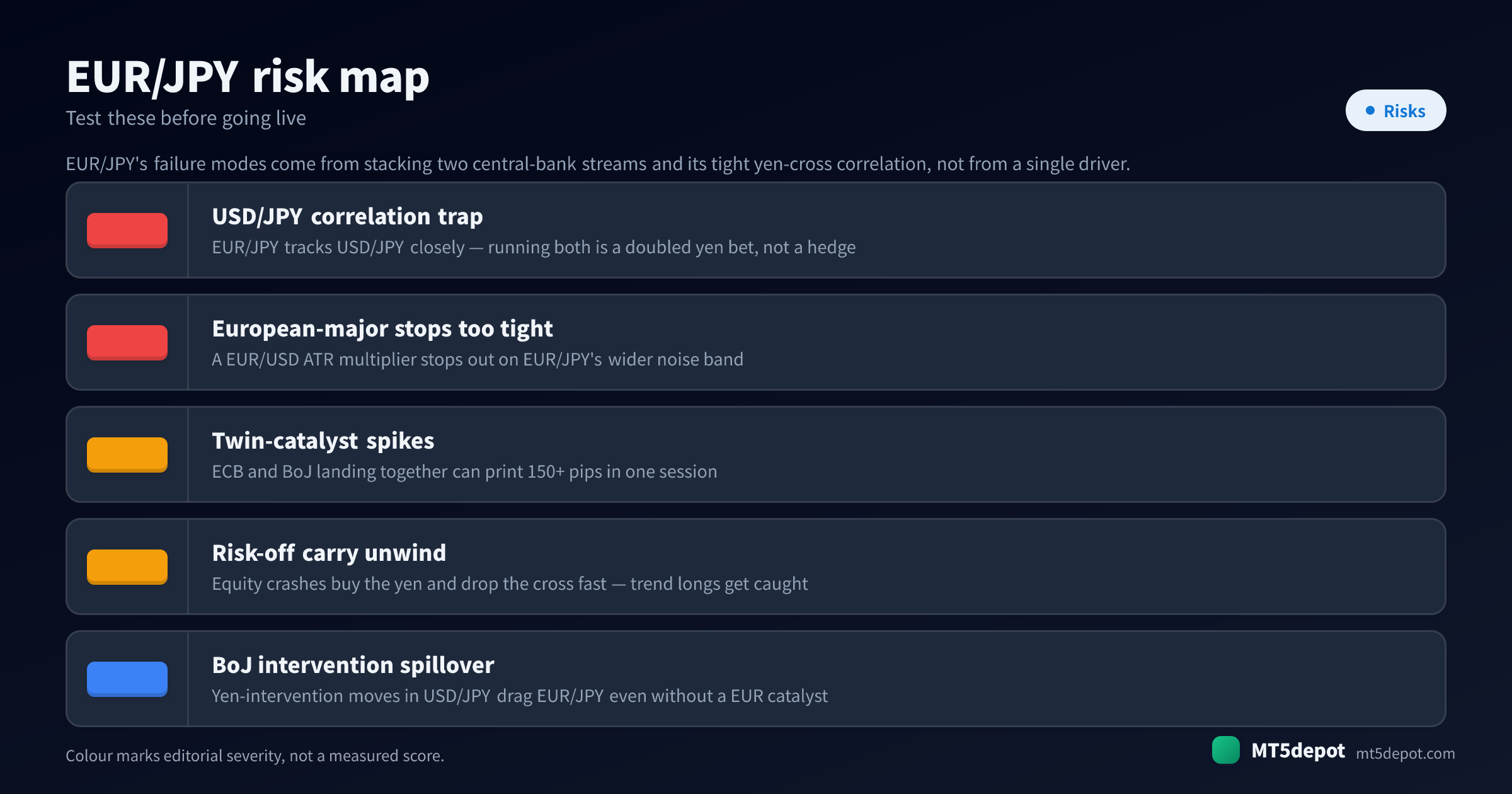
EUR/JPY’s failure modes come from stacking two central-bank streams and its tight yen-cross correlation, not from any single driver. A generic risk checklist misses most of them:
- The USD/JPY correlation trap. EUR/JPY tracks USD/JPY closely because both share the yen leg. Running an EA on each is not a hedge and not diversification — it is a doubled yen bet that concentrates exposure without appearing anywhere in either EA’s risk settings. Confirm the live correlation before you ever pair them in one basket.
- European-major stops are too tight. The most common porting error is copying a EUR/USD EA’s ATR multiplier onto EUR/JPY’s wider noise band, which guarantees premature stop-outs. Scale stops and targets to the pair’s own ATR before anything else — this is the single change that most often decides whether a ported strategy survives here.
- Twin-catalyst spikes. Because two central banks drive the pair, an ECB decision and a BoJ decision landing in the same session can compound into a move of 150+ pips — far beyond a quiet day’s range. A fast strategy needs a news pause across both calendars; a slower one needs stops that survive a stacked-event gap.
- BoJ intervention spillover. Yen-intervention moves originate in USD/JPY, but because EUR/JPY shares the yen leg they drag it too — meaning the cross can lurch hard with no EUR catalyst at all. An EA watching only the European calendar will be blindsided by a move it has no event to explain.
- Risk-off carry unwind. Yuppy is a carry cross, so an equity crash buys the yen and drops the pair fast; trend longs built in a calm regime get caught on the wrong side of a sudden unwind. Test how the strategy behaves in a sharp risk-off leg, not just in the trending stretches.
How to Test a EUR/JPY EA
On EUR/JPY, the test is the whole edge. Hold anything you build to the bar set out in the site’s methodology:
- Backtest on tick data at your account’s real spread. Use an every-tick model with the standard-or-raw spread you will actually trade — wider than EUR/USD — not the platform default. A strategy validated at a spread it will never see is a fiction, and this is where the typical-vs-measured gap above becomes real money.
- Read the worst losing streak, not the headline profit factor. The max drawdown and the longest run of losing trades tell you the capital and the patience the strategy demands. Budget for the worst streak before you fund it.
- Forward-test on demo through one ECB and one BoJ event. EUR/JPY’s defining risk is its two-central-bank structure, so a demo window that never spans a decision from both has not tested the thing that matters most. Ideally catch a session where the two calendars sit close together.
- Confirm the server clock before the first live trade. Re-check MT5’s Market Watch time against the UTC session hours above, and re-check it again after any broker migration — a step that is easy to skip and expensive to miss.
Every backtest number this produces is a historical measurement, not a forecast — say so in your own notes, and size for the drawdown you measured rather than the return you hope for.
EUR/JPY EAs and Builder Templates
We have not published a EUR/JPY backtest of our own, and a EUR/USD result does not carry over to a pair whose range compounds two central banks’ decisions. The honest route to a Yuppy EA is to build and verify one:
- The Builder (open it here) accepts EUR/JPY in its trend and breakout templates. The EA you deploy is built on your own numbers, and the CTA below covers exactly what it produces.
- Related-pair reference. GBP/JPY shares EUR/JPY’s yen leg and its wide-cross volatility character, so stops and session filters that survive its noise make a useful stress comparison. A result on one cross is still not evidence for the other: their non-yen legs answer to different central banks.
- The concept canonicals. If a term above is unfamiliar, the volatility, ATR and swap entries define the mechanics a EUR/JPY EA depends on.