Cable is EUR/USD with the volume turned up: a materially wider daily range, a UK-specific risk layer, and faster spread excursions around news. The first thing to decide is whether your strategy wants that volatility or merely tolerates it. Trend and breakout EAs feed on GBP/USD’s London-open expansion; a mean-reversion or scalping system sized for EUR/USD meets wider stops and worse fills here. Pick the pair to the strategy, not the other way round.
This page covers what GBP/USD gives an automated strategy that EUR/USD does not, the sessions that decide its results, what it costs, the failure modes that catch systems ported over from calmer pairs, and how to build and test a GBP/USD EA of your own.
How GBP/USD Behaves: What Cable Gives an EA
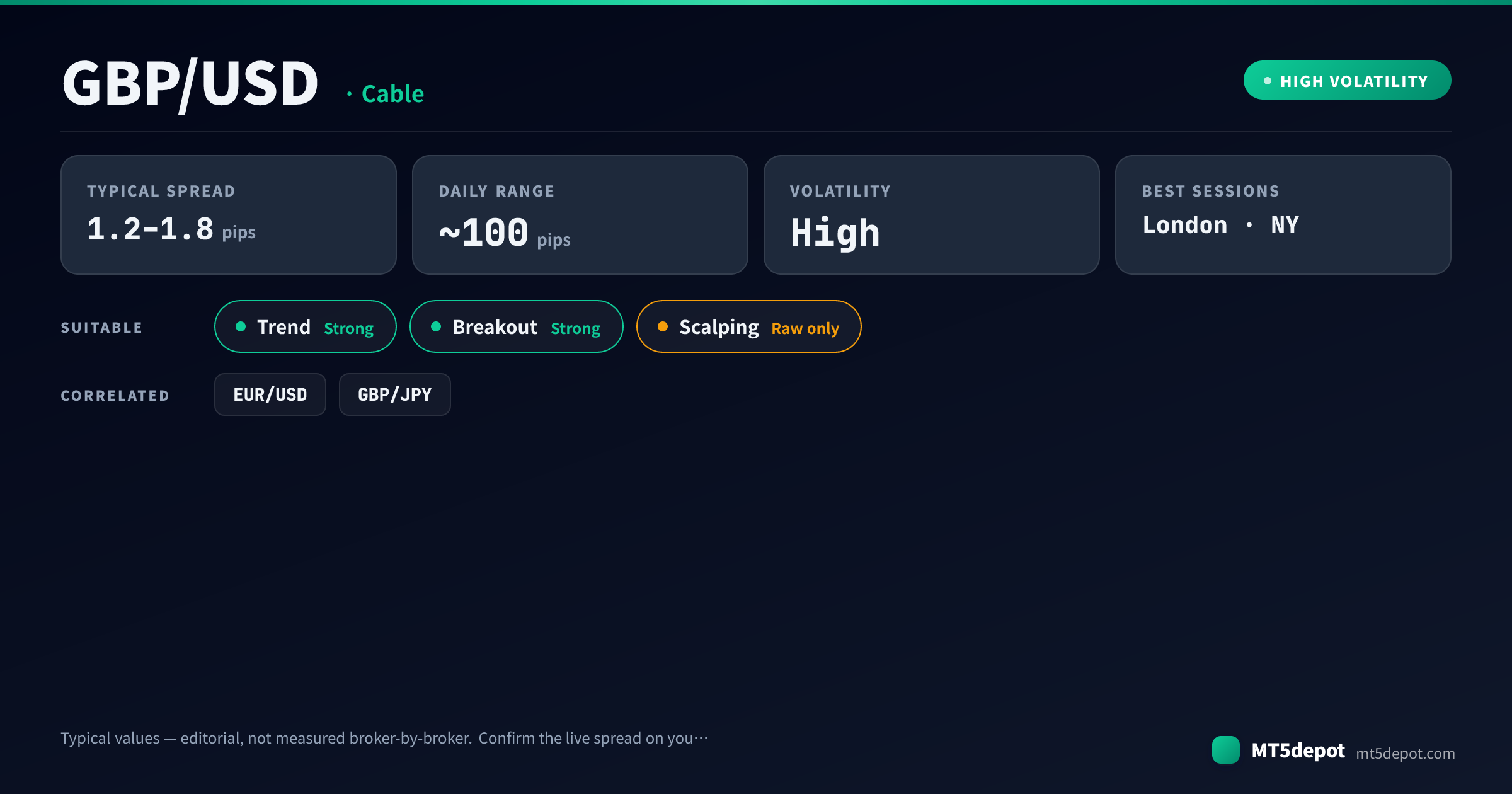
GBP/USD — universally called “Cable” after the transatlantic telegraph cable that once carried the rate — trades a large share of global forex volume and carries a volatility premium over EUR/USD that is not noise. It reflects an additional layer of UK-specific catalysts (Bank of England policy, residual post-Brexit political sensitivity) stacked on top of the shared USD baseline.
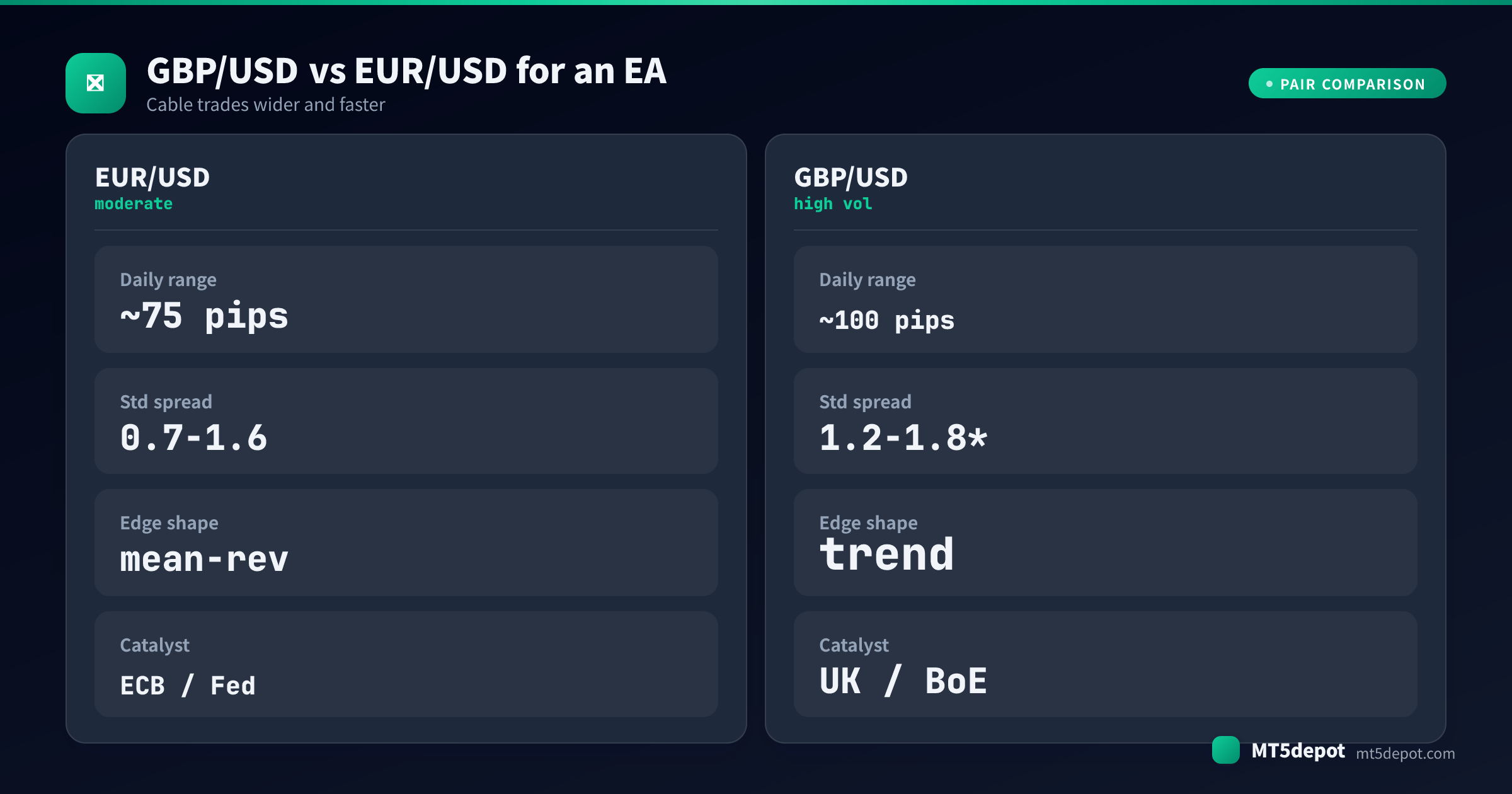
For an EA, that character reduces to three properties:
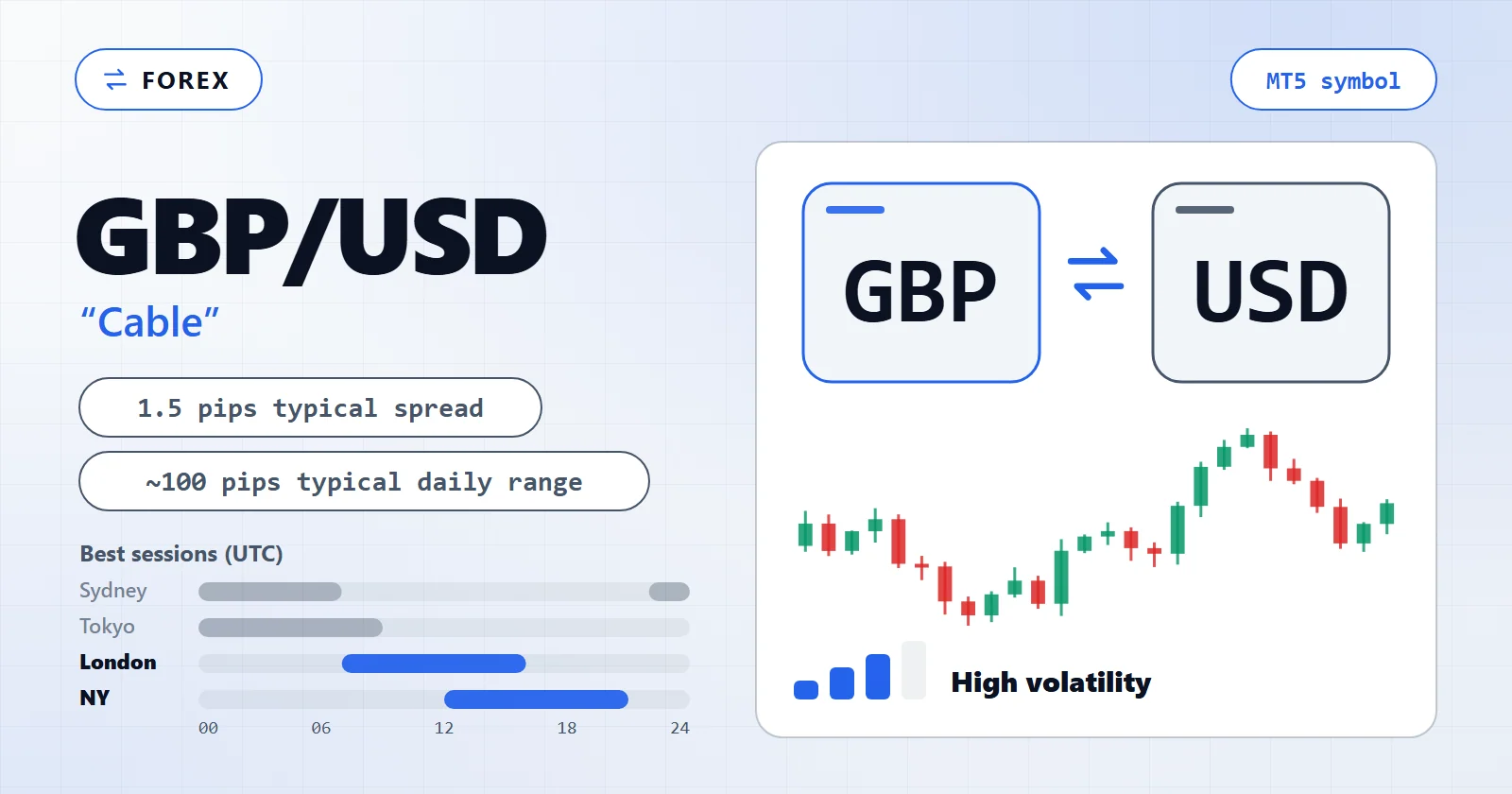
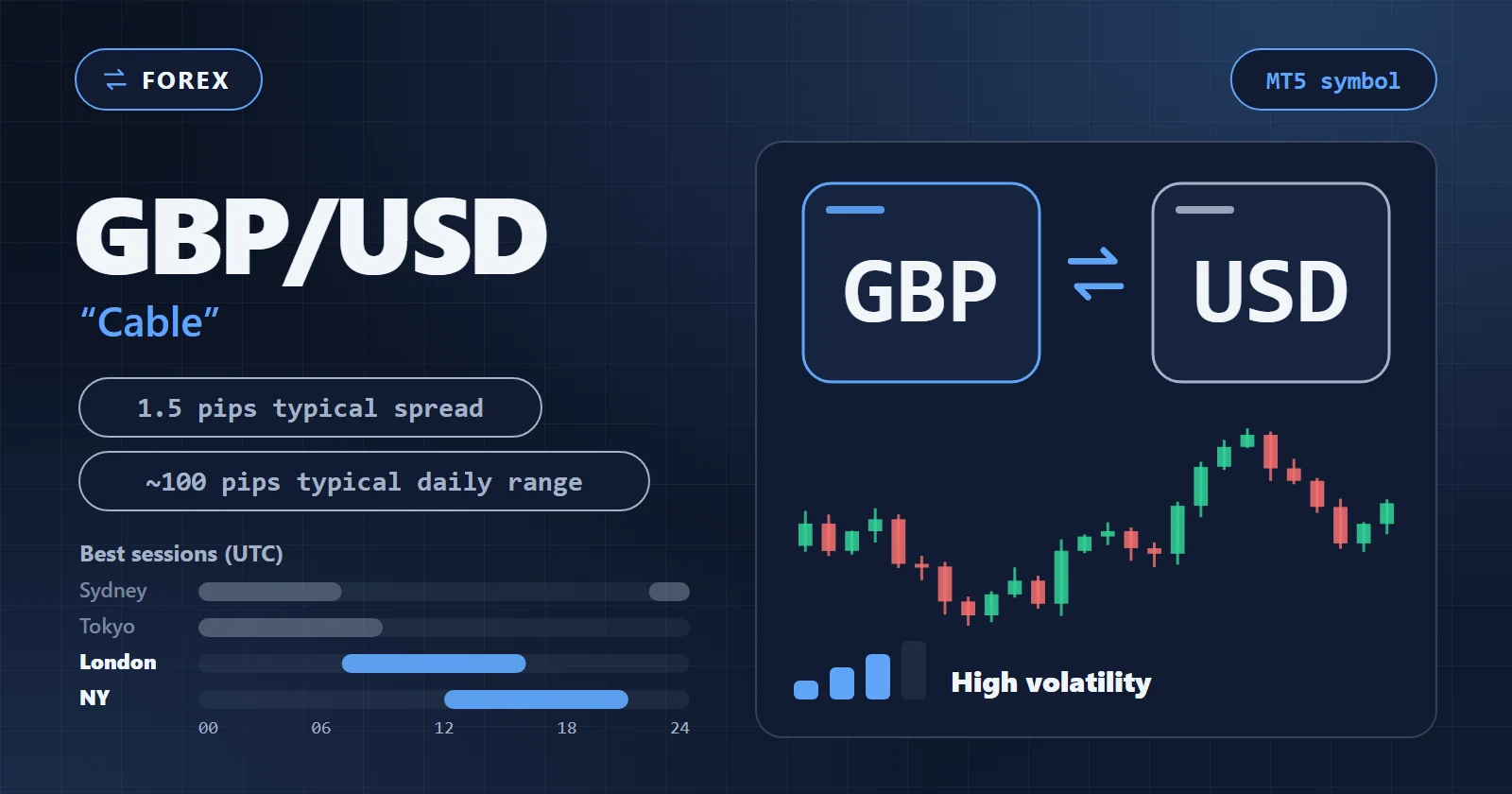
- Higher volatility, wider range. Our published typical daily range for Cable is near 100 pips — labelled typical, not measured broker-by-broker — and it tends to run wider than EUR/USD’s, which gives breakout systems more room to pay a 2:1 target. That extra range is the single fact that everything else on this page follows from.
- Range expansion on the London open. GBP/USD tends to consolidate through the thin overnight hours, then expand sharply in the early London hours (roughly 07:00–11:00 UTC). Strategies that specifically target that expansion often find their cleanest edge here.
- UK-event sensitivity. BoE decisions, UK inflation and employment prints move Cable harder than comparable US-only events move EUR/USD. That is opportunity for a trend EA with an event pause and a landmine for a system with no event filter.
The trap for automated strategies is that the volatility which looks like edge on a backtest is also the volatility that widens spreads and gaps prices at exactly the moments an EA concentrates its trades. Cable rewards systems that respect its volatility and quietly drains ones that assume a EUR/USD-shaped range.
Which EA Strategies Suit GBP/USD?
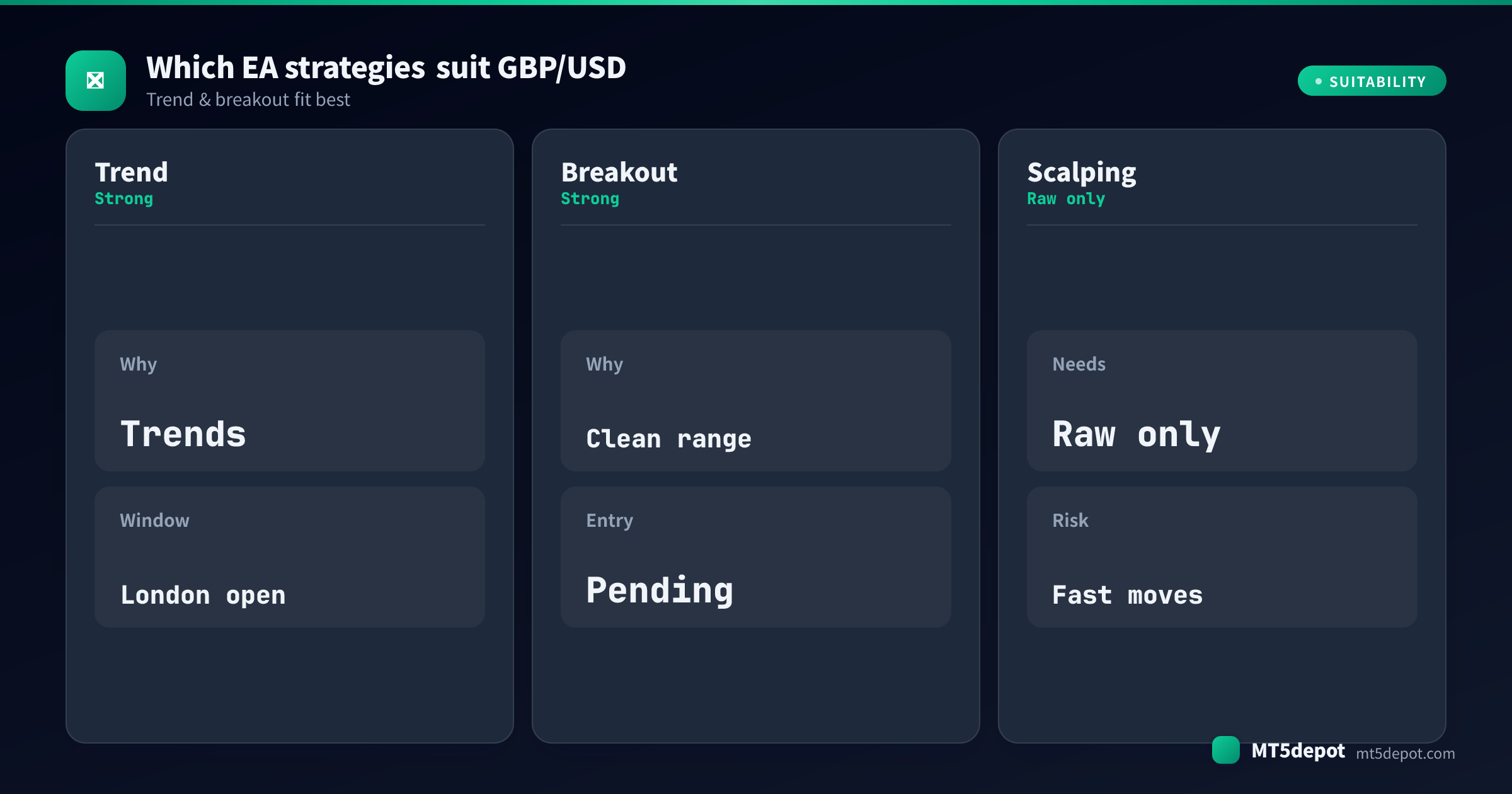
The pair’s profile lists trend, breakout, and scalping as suitable — but suitability is not proof. In our own stock-settings baseline of the Builder’s templates — a single USD/JPY M5 run over one year, default inputs, no optimisation — most finished below a 1.0 profit factor. The only GBP/USD exposure in it came from one leg of the dual-pair RSI basket template, which also finished below 1.0. Almost none cleared the Builder’s own bar at stock settings, so treat any edge on GBP/USD as something your own settings and test have to earn. Look for it in mechanics — pending stop orders, session windows — not the indicator on the box. What Cable’s character supports specifically:
| Strategy | Fit on Cable | Why |
|---|---|---|
| Trend-following | Strong | GBP/USD often produces sustained directional moves; entering on the London-open range break is a common way to use its volatility premium. |
| Breakout (pending orders) | Strong | The overnight consolidation and London resolution give an objective range. Pending-order entries at the range edge are less spread-sensitive than market fills — which matters more on a wider-spread pair. |
| Scalping | Raw accounts only | The cost math needs sub-pip spread plus commission, and Cable’s faster excursions punish thin stops. Treat any scalper as unproven until a tick-data test says otherwise. |
| Multi-symbol basket | Handle with care | GBP/USD is available as a leg in the Builder’s templates, but its correlation with EUR/USD and GBP/JPY is a risk covered below — a “diversified” basket across them is closer to one leveraged position. |
Trend and breakout are the shapes that turn Cable’s range into an asset; the rest have to fight the spread and the noise. The practical route is to build one of these shapes yourself — the Builder ships templates that accept GBP/USD and exposes every parameter — and then test it (below) before you trust a single number.
Best Trading Hours for GBP/USD EAs
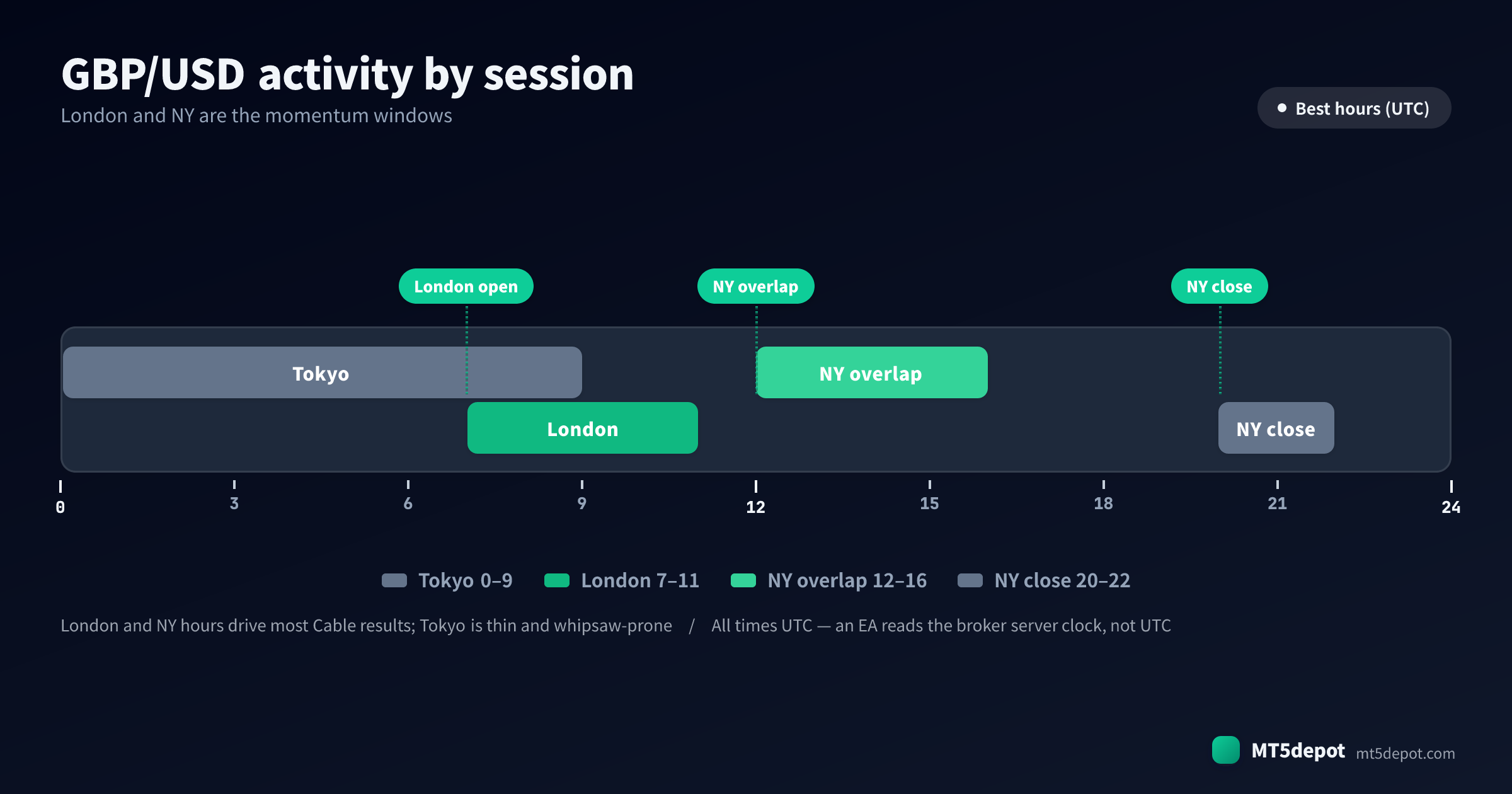
Session structure decides more of a Cable result than indicator choice does:
- Tokyo session (00:00–09:00 UTC): thin liquidity, range-bound, prone to whipsaw. Trend EAs using H1 signals generate false entries here, and range moves often reverse at the London open.
- London open (07:00–11:00 UTC): the primary directional window. GBP pairs commonly expand fastest here — an effect usually attributed to BoE-linked flow — and this is where breakout and trend EAs on Cable tend to earn most of their result.
- NY overlap (12:00–16:00 UTC): the secondary momentum window. US data releases drive the dollar leg as strongly as they move EUR/USD, so GBP/USD gets a second daily surge.
- NY close (20:00–22:00 UTC): range contraction and false breakouts; session-quality filters should exclude these hours.
In our editorial assessment, EAs that restrict trading to the London-and-NY hours often out-perform 24-hour variants on Cable, so a session filter is best treated as part of the strategy definition rather than an optimisation flourish — a hypothesis worth testing on your own data. Two cautions come with it. Scheduled BoE and Fed events sit inside those good windows and widen spreads exactly then, so a fast strategy needs a news pause or it pays triple spread at the worst moment. And every clock time above is UTC — an EA reads your broker’s server clock, which is usually not UTC, so a “07:00” filter shifts silently when you move the EA between brokers on different server timezones. This is the one clock rule for the whole page; verify it once, in MT5’s Market Watch, and every session boundary lines up.
Spreads, Costs, and Execution
GBP/USD is more expensive to trade than EUR/USD. The figures below are editorial reference ranges compiled from broker-published standard and raw conditions (updated July 2026), not broker-by-broker measured numbers — our live spread sampling currently covers EUR/USD and a few reference symbols, so confirm the live spread on your own account before you size a fast strategy:
| Account type | Typical GBP/USD spread | Commission | Who it suits |
|---|---|---|---|
| Standard | 1.2 – 1.8 pips | none | swing / low-frequency trend EAs |
| Raw / ECN | sub-pip (≈0.2 – 0.5) | $3 – 7 / lot | scalping / high-frequency EAs |
Two cost rules specific to this pair:
- Budget wider than EUR/USD, and confirm on your own account. EUR/USD’s typical standard spread starts around 0.7 pips (a typical reference range, not a measured figure; confirm it on your own account). Cable’s standard spread typically runs wider, in the 1.2–1.8 range above. That extra width is a rounding error for a swing EA and a recurring tax for a high-frequency one — which is why fast GBP/USD systems belong on raw-type accounts where the spread compresses to a known number.
- The commission is an account property, not a pair property. The same $3–7/lot raw commission applies whether you trade EUR/USD or Cable; what changes between pairs is the spread on top of it. A GBP/USD scalper validated at 0.5 pips all-in and deployed at 1.8 is running a different strategy from the one you tested.
Risks to Test Before Going Live
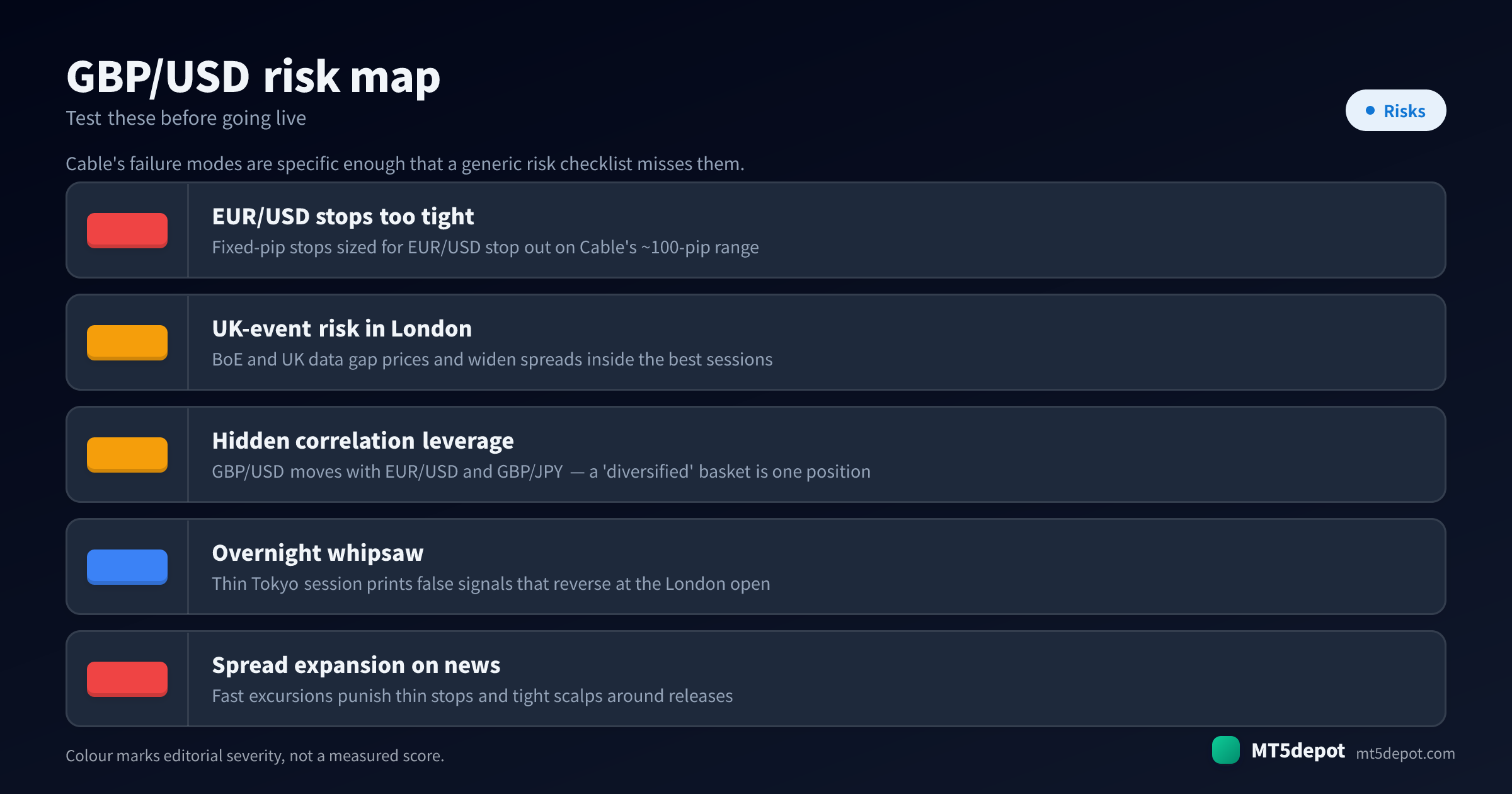
Cable’s failure modes are specific enough that a generic risk checklist misses them:
- EUR/USD stops are too tight for Cable. The most common porting error is copying a EUR/USD EA’s fixed-pip stop onto Cable’s materially wider range, which guarantees premature stop-outs. Re-size stops and targets to the pair’s own ATR before anything else — this is the single change that most often decides whether a ported strategy survives.
- UK-event risk clusters inside the best sessions. BoE decisions and UK data prints gap prices and widen spreads inside the London window where Cable EAs concentrate. Fast strategies need a news pause; slower ones need stops that survive a large event gap.
- Correlation is hidden leverage. GBP/USD moves with EUR/USD and GBP/JPY. Two “diversified” EAs on GBP/USD and EUR/USD are closer to one leveraged position than a hedge — the correlation doubles your exposure without appearing anywhere in either EA’s risk settings. The same GBP leg sits inside GBP/CAD as well, so adding a GBP cross to a Cable book stacks one currency’s risk under two symbol names.
- Overnight whipsaw manufactures false signals. The thin Tokyo session prints moves that reverse at the London open. An unfiltered trend EA reading H1 signals overnight trades noise, not trend.
How to Test a GBP/USD EA
On Cable, the test is the whole edge. Hold anything you build to the bar set out in the site’s methodology:
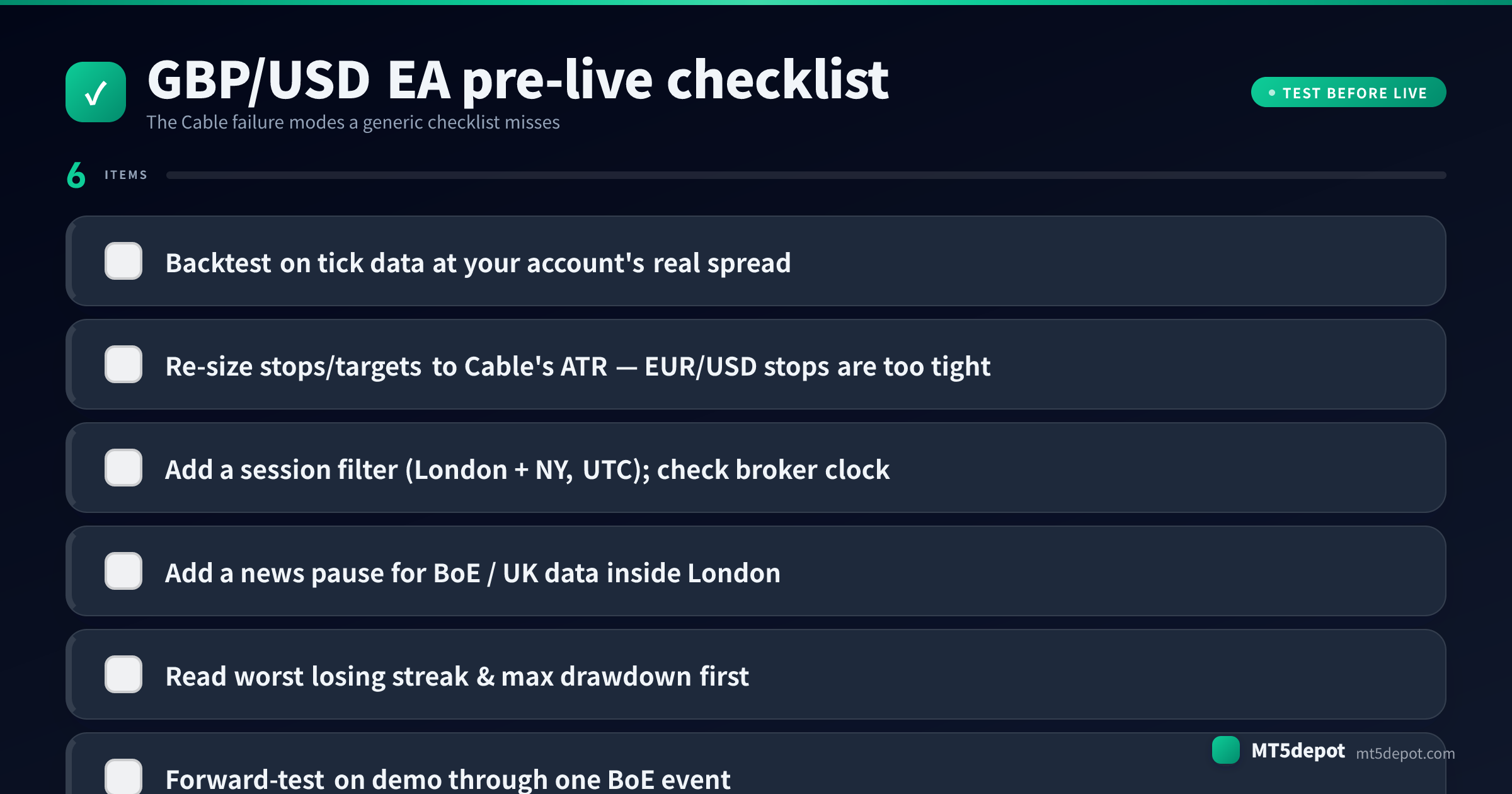
- Backtest on tick data at your account’s real spread. Use an every-tick model with the standard-or-raw spread you will actually trade, not the platform default. A strategy validated at a spread it will never see is a fiction — this is where the typical-vs-measured gap above becomes real money.
- Read the worst losing streak, not the headline profit factor. The max drawdown and the longest run of losing trades tell you the capital and the patience the strategy demands. Budget for the worst streak before you fund it.
- Forward-test on demo through at least one BoE event. Cable’s defining risk only shows up around UK catalysts, so a demo window that never spans a rate decision or an inflation print has not tested the thing that matters most.
- Confirm the server clock before the first live trade. Re-check MT5’s Market Watch time against the UTC session hours above, and re-check it again after any broker migration — a step that is easy to skip and expensive to miss.
Every backtest number this produces is a historical measurement, not a forecast — say so in your own notes, and size for the drawdown you measured rather than the return you hope for.
GBP/USD EAs and Builder Templates
We have not published a GBP/USD backtest of our own, and a EUR/USD result does not carry over to Cable’s wider range and UK-event gaps. The honest route to a Cable EA is to build and verify one:
- The Builder (open it here) accepts GBP/USD in its trend, breakout, and multi-symbol basket templates, so the EA you deploy is built on your own numbers — the CTA below covers exactly what it produces.
- Related-pair reference. GBP/JPY shares Cable’s GBP leg and its volatility character, so stops and session filters that survive its noise make a useful stress comparison — but a result on GBP/JPY is not evidence for Cable, because the yen leg moves on a different calendar.
- The concept canonicals. If a term above is unfamiliar, the spread, volatility and ATR entries define the mechanics a Cable EA depends on.