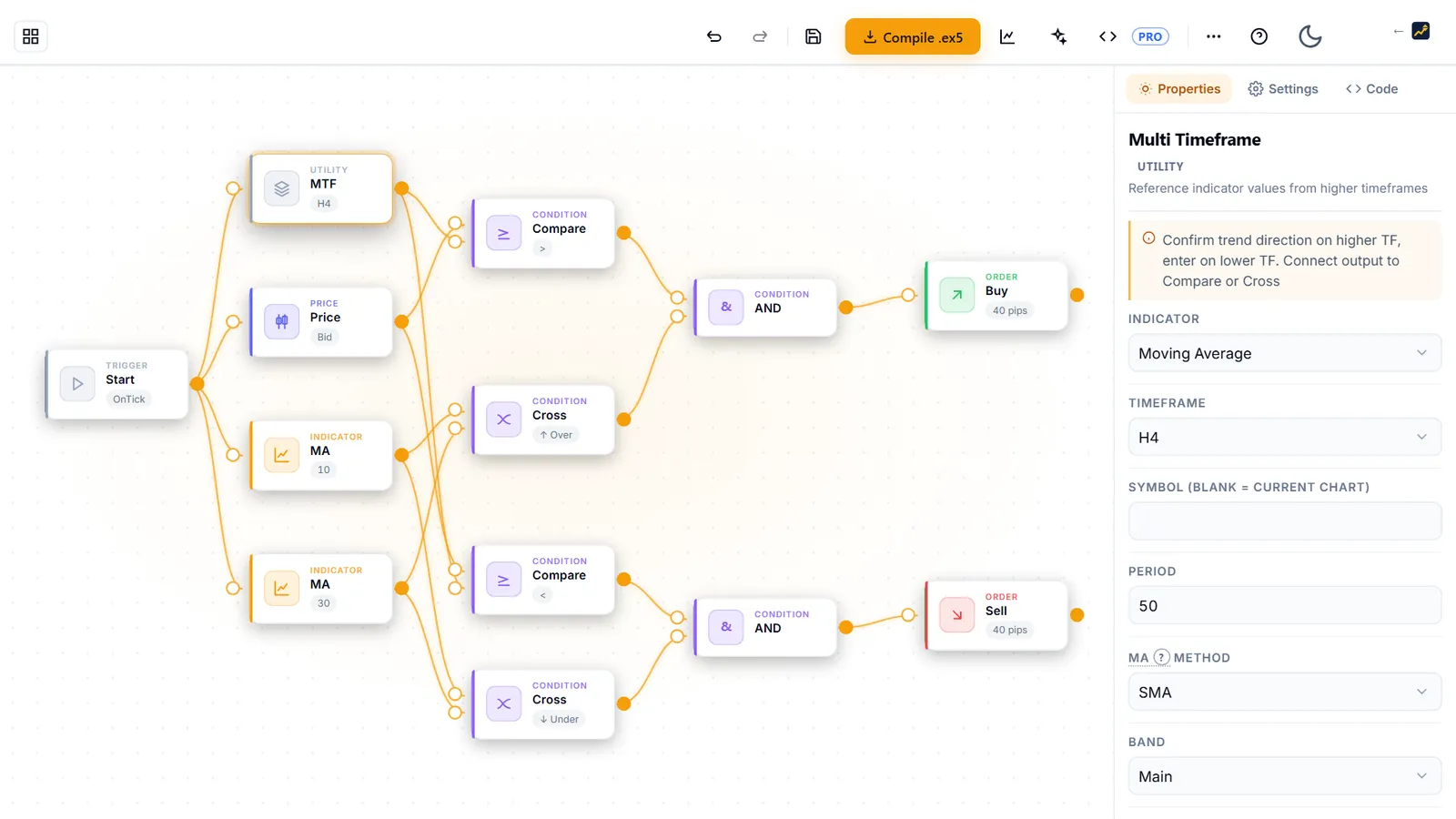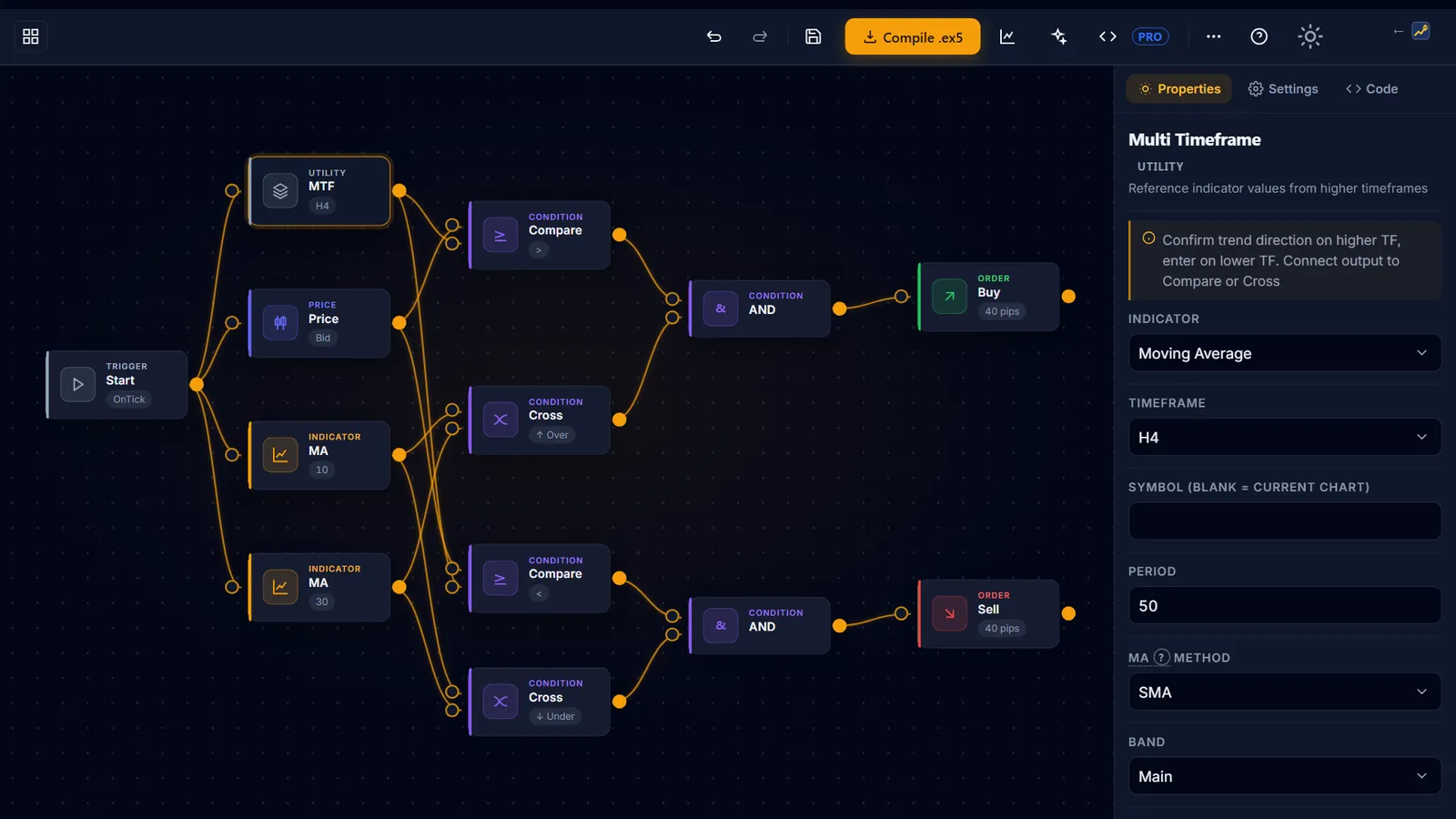
Gold is not a currency pair. It is a macro asset that happens to be quoted against the US dollar. Real interest rates, dollar strength and geopolitical risk premia — not an interest-rate differential between two economies — are what move XAU/USD. They move it in multi-month trends that dwarf anything a forex major produces. The first thing to decide is whether your strategy wants that character or merely tolerates it. A trend or breakout EA feeds on gold’s large range, while a system sized and stopped for EUR/USD meets ten times the per-pip risk and a range four times as wide the moment it touches gold. Pick the instrument to the strategy, not the other way round.
This page covers what gold gives an automated strategy that a forex pair does not, the sessions that decide its results, and what it costs. It then covers the failure modes that catch systems moved over from FX majors, and how to build and test a gold EA of your own.
How XAU/USD Behaves: What Gold Gives an EA
Gold is structurally different from a forex major in a way that matters more for automation than any indicator choice. It is a macro asset, so its catalysts and its arithmetic both sit outside the FX world an EA was probably designed for.
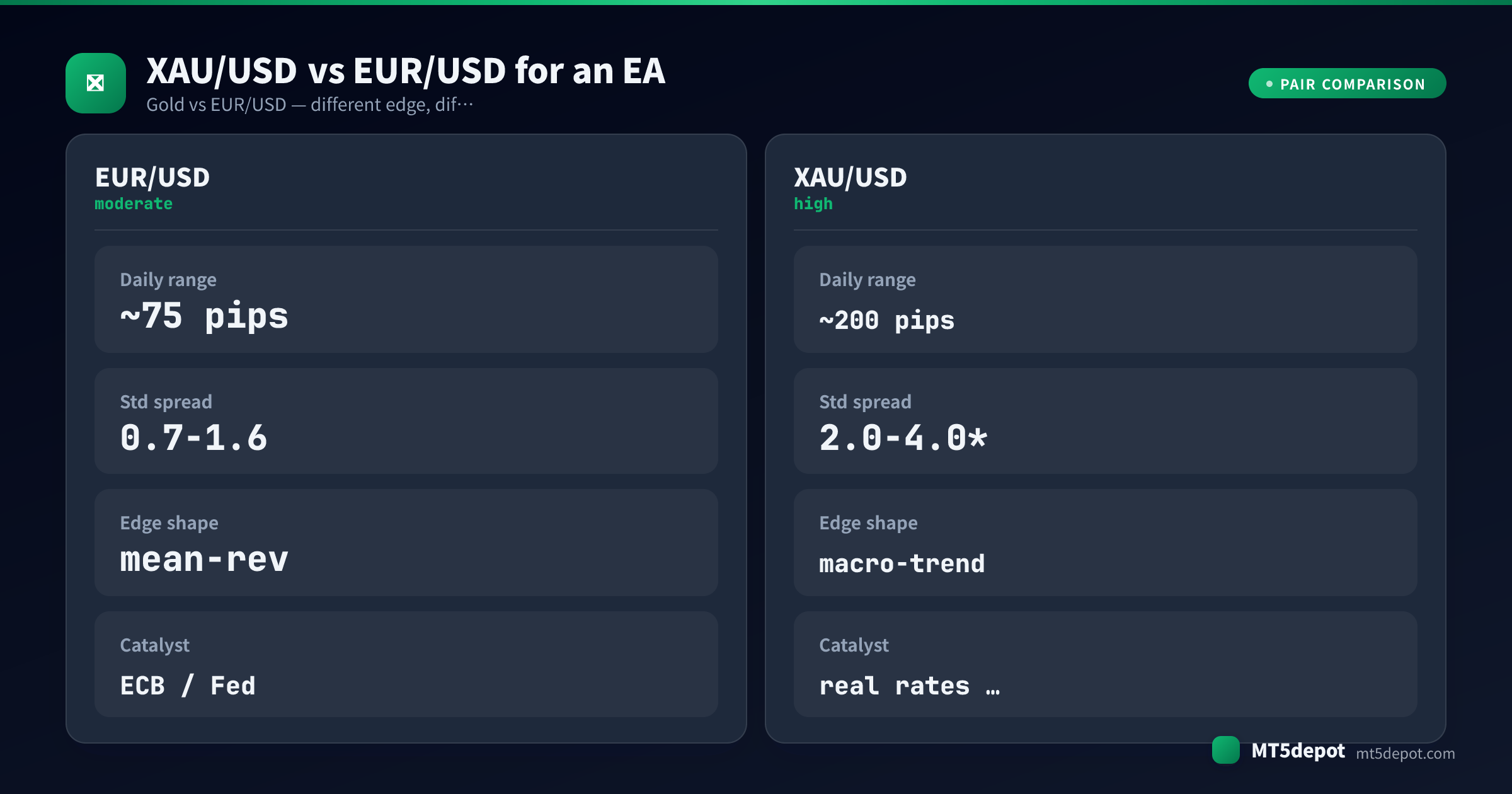
For an EA, that character reduces to three properties:
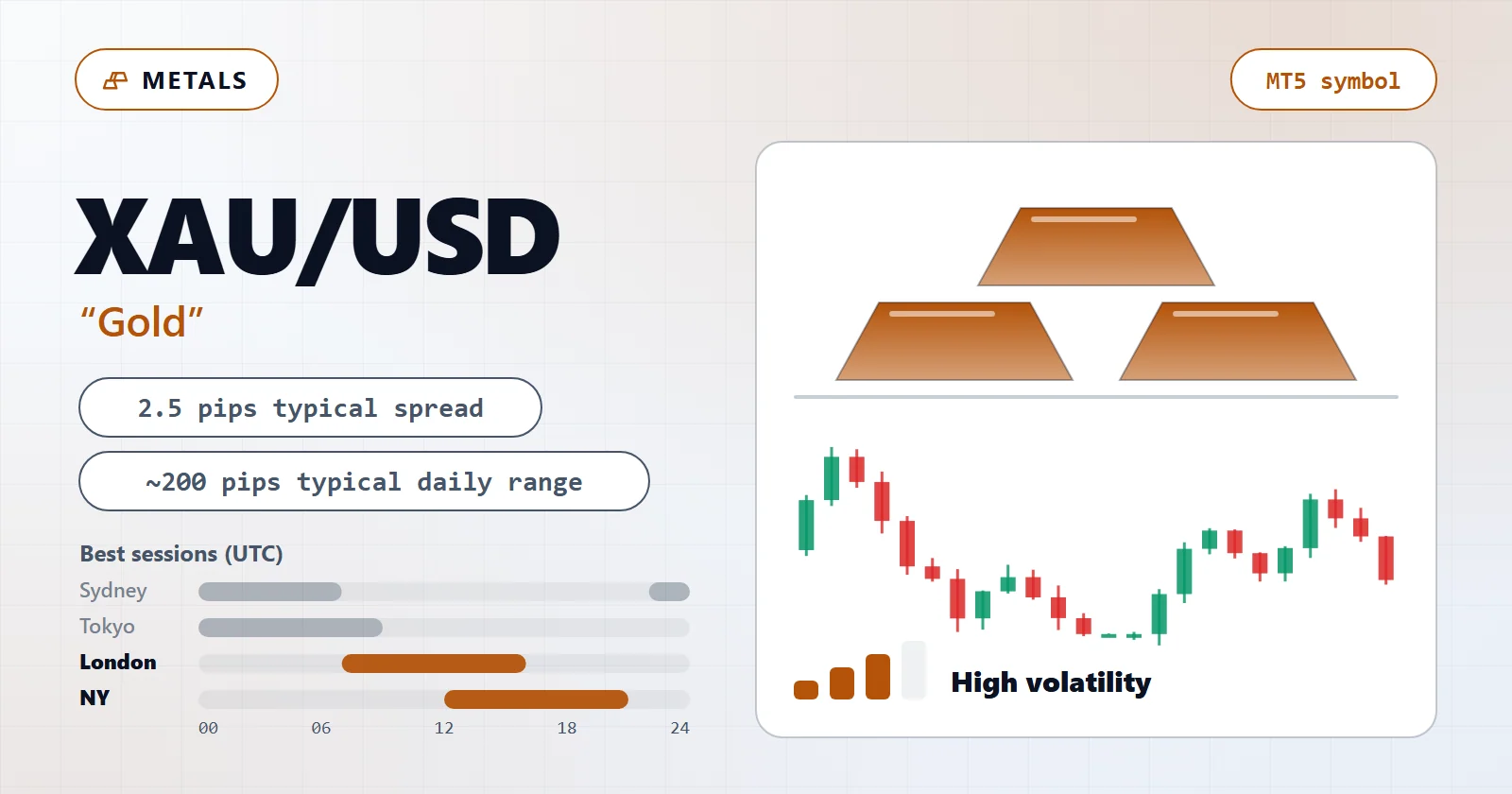
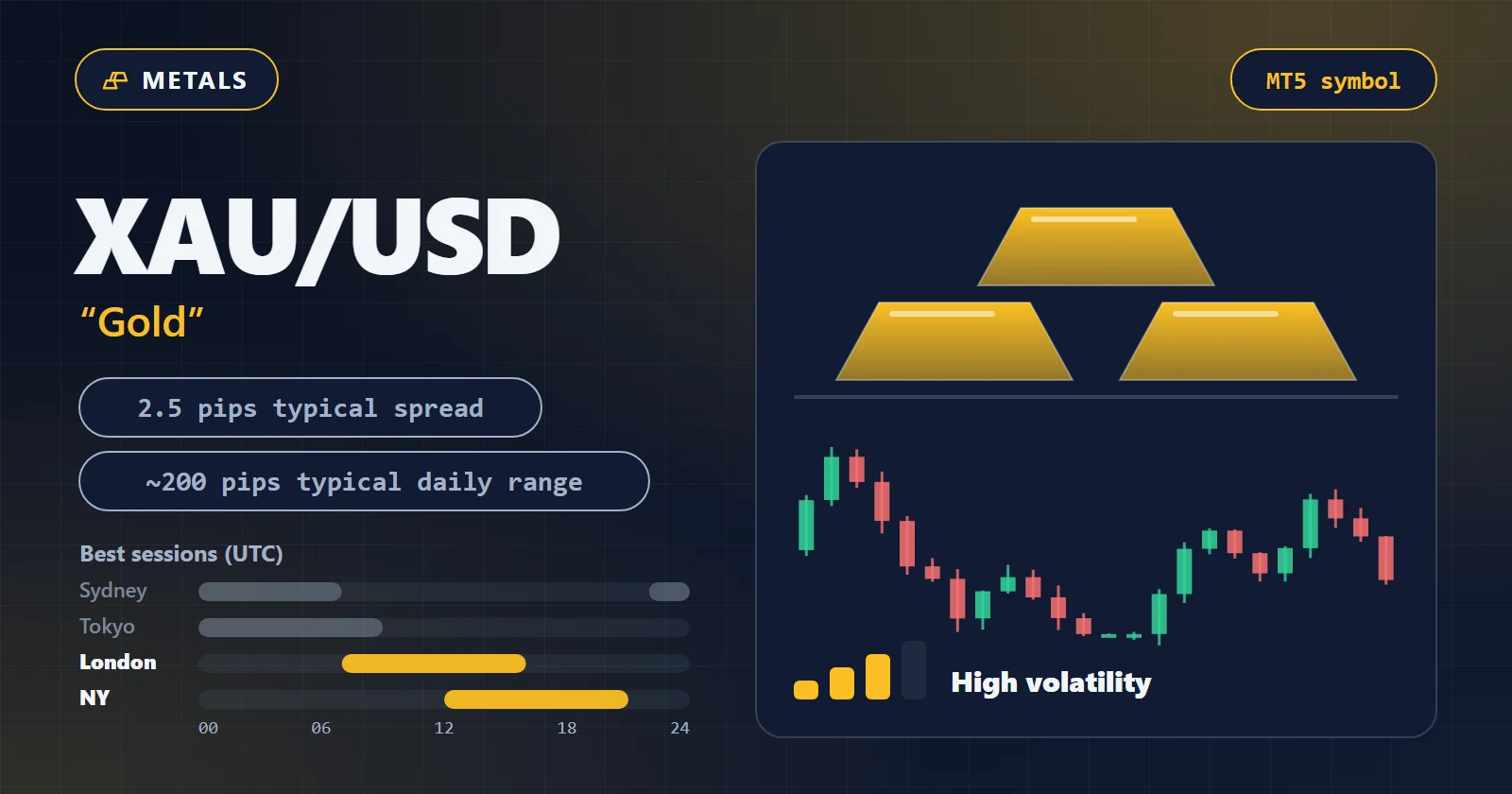
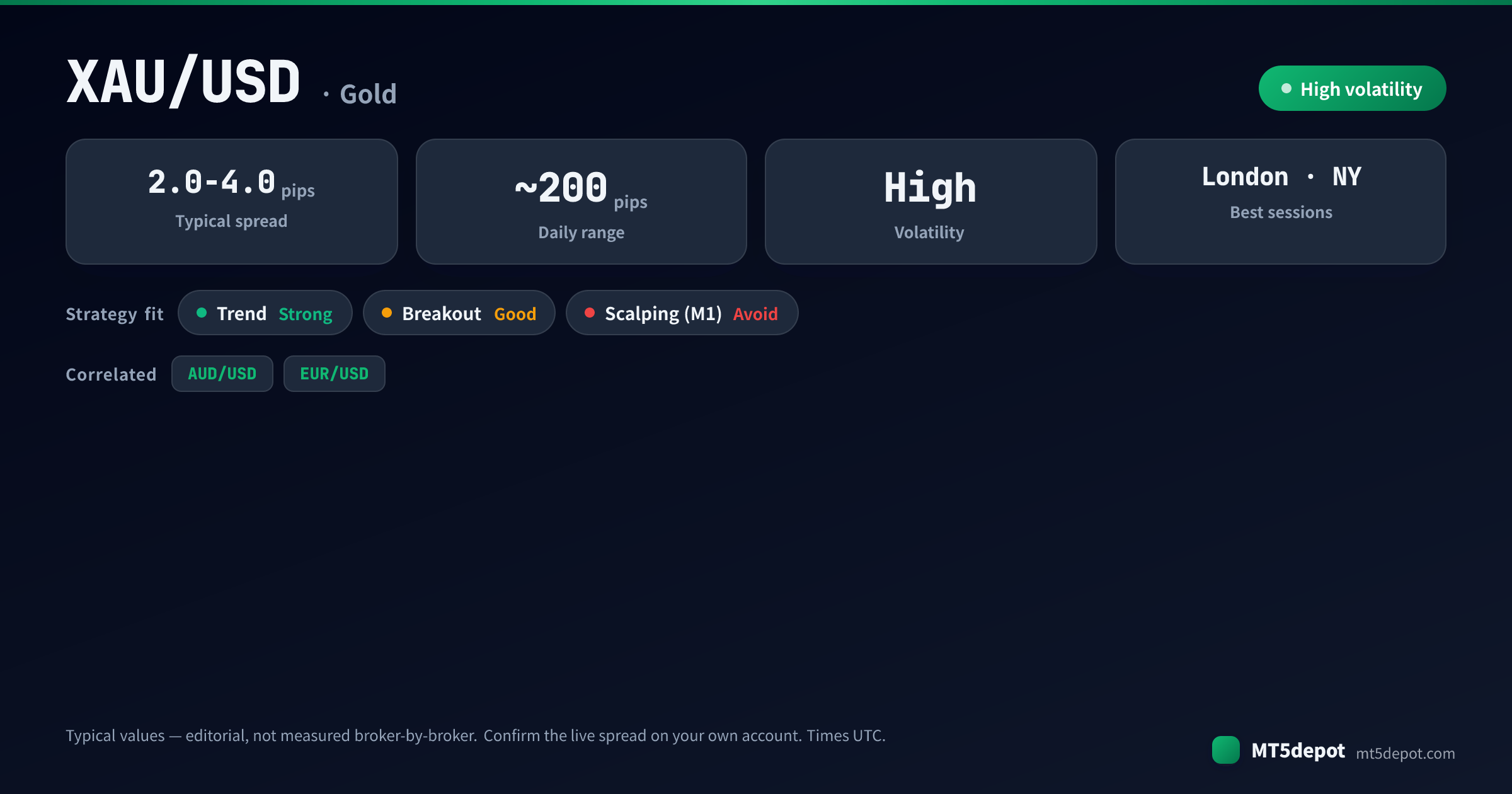
- A large ATR and a ~200-pip range. Our published typical daily range for gold is near 200 pips — labelled typical, not measured broker-by-broker — roughly two to three times a major’s. That range gives trend and breakout systems room to run, but an FX-sized stop sits inside the day’s normal noise. Re-sizing stops and targets to gold’s own ATR is the fact everything else here follows from.
- $100 per pip at standard sizing. This is contract mechanics, not a live measurement: a standard gold lot moves roughly $100 per pip against about $10 for a forex major. The same lot size that is prudent on EUR/USD carries ten times the per-pip risk on gold. Leverage and position sizing — not the entry signal — decide whether a gold EA survives its first large move.
- Macro catalysts, not FX ones. Gold reacts to real-rate shifts, US dollar regime changes and risk-premium spikes, which can reverse a multi-week trend with no forex catalyst on the calendar. A trend EA reading price alone often has no idea the driver behind its position has just flipped.
The trap for automated strategies is that gold’s large, clean range looks like an easy edge on a backtest. That same range, plus $100/pip sizing, turns one ordinary move into an account event if the lots were copied from a forex system. Gold rewards strategies that respect its volatility regime and its sizing arithmetic, and quietly ruins ones that treat it as EUR/USD with a bigger number.
Which EA Strategies Suit XAU/USD?
The instrument’s profile lists trend and breakout as suitable — but suitability is an editorial assessment, not proof. In our own stock-settings baseline of the Builder’s templates — a single USD/JPY M5 run over one year, default inputs, no optimisation — most finished below a 1.0 profit factor, and that run was not on gold. Almost none cleared the Builder’s own bar at stock settings, so treat any edge on gold as something your own settings and test have to earn. Look for it in mechanics — timeframe, session windows, sizing discipline — not the indicator on the box. What gold’s character tends to support:
| Strategy | Fit on XAU/USD | Why |
|---|---|---|
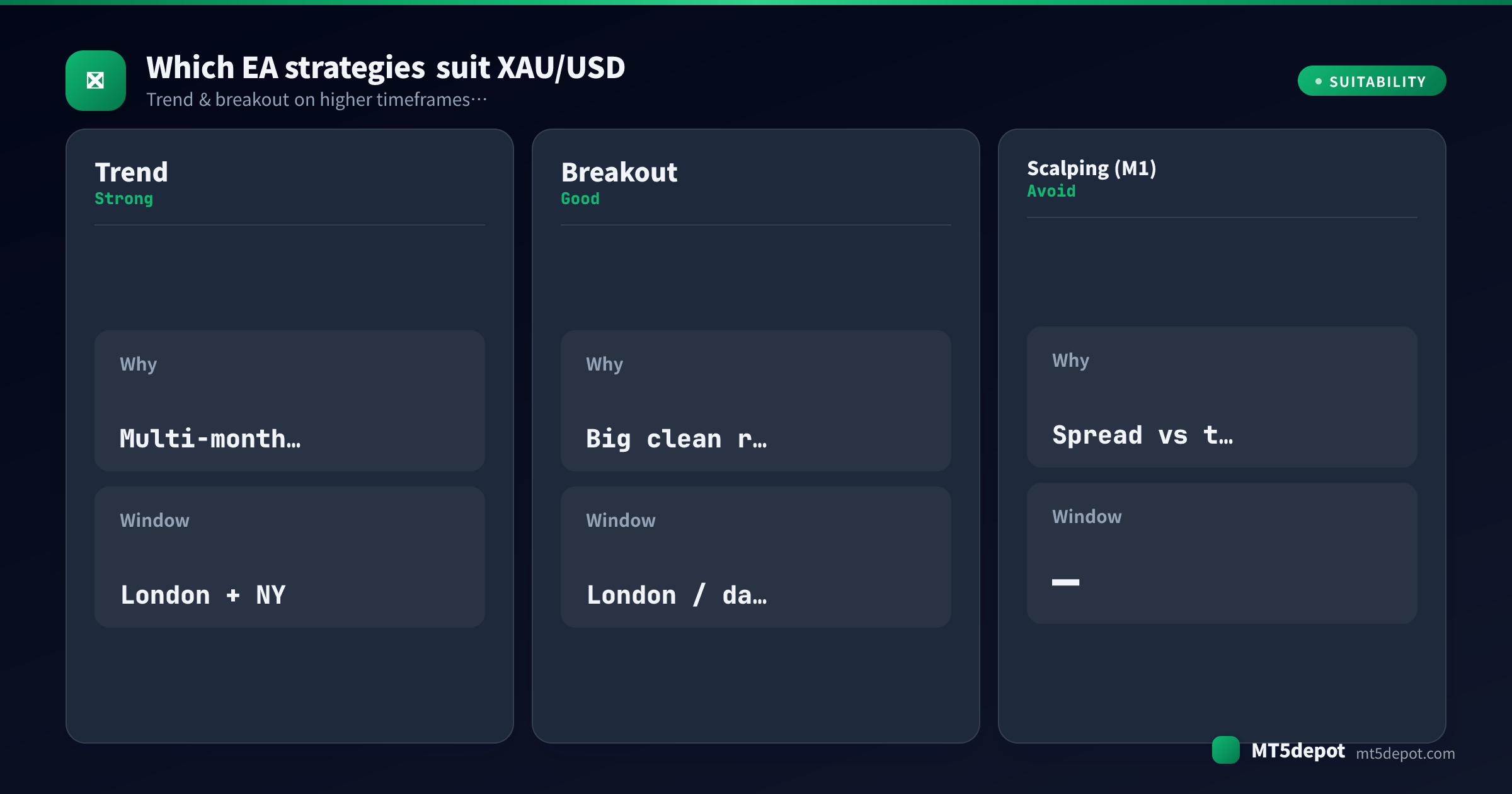
| Trend | Strong | Gold’s multi-month directional moves suit momentum systems on M15/H1 — the large range gives a 2:1 or 3:1 target room to fill. |
| Breakout | Good | The big, clean ranges around London and data prints give an objective level to break; pending-order entries reduce the spread cost that a market fill pays on a wide-spread instrument. |
| Scalping (M1) | Avoid | A 2–4 pip spread is often 4–10% of a small target, and gold’s fast excursions hit tight stops — the cost math rarely clears on M1. |
Trend and breakout on the higher timeframes are the shapes that turn gold’s range into an asset. M1 scalping has to fight the spread and the noise at once. The practical route is to build one of these shapes yourself. The Builder ships templates that accept XAU/USD and exposes every parameter, including lot size — then test it (below) before you trust a single number.
Best Trading Hours for XAU/USD EAs
Session structure decides more of a gold result than indicator choice does:
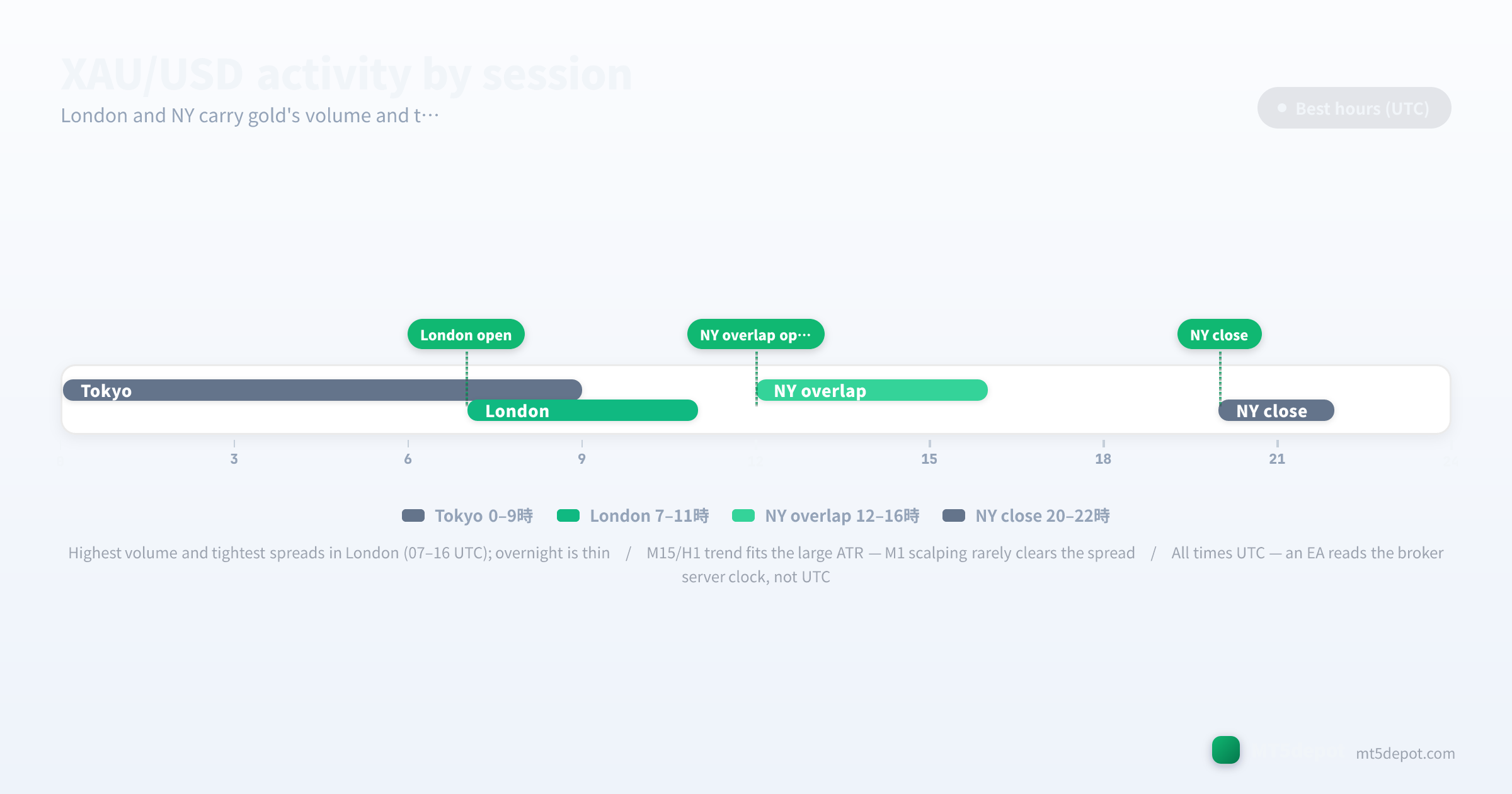
- Sydney / Tokyo overnight (roughly 21:00–07:00 UTC): thin liquidity and low conviction. Gold prints breakouts here that often fail once real depth arrives, so this window is best excluded by a session-quality filter.
- London session (07:00–16:00 UTC): gold’s primary window. Volume is highest and spreads are tightest here, and trend and breakout EAs on gold tend to earn most of their result in these hours.
- NY overlap (12:00–16:00 UTC): the second momentum window. US data — CPI, FOMC, non-farm payrolls — moves the dollar and real-rate leg that drives gold. This overlap with late London is often the most active stretch of the day.
- Late NY (16:00–21:00 UTC): activity fades into the overnight; conviction drops and false signals return.
EAs that restrict trading to the London-and-NY windows often out-perform 24-hour variants on gold, in our editorial assessment. Treat a session filter as part of the strategy definition rather than an optimisation flourish. Two cautions come with it. Scheduled US events sit inside those good windows and widen the gold spread exactly then. A fast strategy needs a news pause, or it pays several times the normal spread at the worst moment. And every clock time above is UTC. An EA reads your broker’s server clock, which is usually not UTC, so a “07:00” London filter shifts silently when you move the EA between brokers on different server timezones. Verify it once in MT5’s Market Watch, and every session boundary lines up.
Spreads, Costs, and Execution
Gold is more expensive to trade than a forex major, and the cost interacts with its sizing in a way FX cost assumptions miss. The figures below are editorial reference ranges compiled from broker-published standard and raw conditions (updated July 2026), not broker-by-broker measured numbers; our live spread sampling currently covers a few FX reference symbols. Confirm the live spread on your own account before you size a fast strategy:
| Account type | Typical XAU/USD spread | Commission | Who it suits |
|---|---|---|---|
| Standard | 2.0 – 4.0 pips | none | swing / trend / breakout EAs on M15–H1 |
| Raw / ECN | 1.5 – 2.5 pips | $3 – 7 / lot | tighter-cost trend / breakout EAs |
Two cost rules specific to this instrument:
- The spread is a share of the target, not a rounding error. A 2–4 pip gold spread can be 4–10% of a 30–50 pip target, which is why small-target and M1 systems rarely clear it. Targeting the larger moves gold’s range naturally offers keeps the spread a small fraction of each trade rather than the difference between profit and loss.
- The commission is an account property, not an instrument property. The same $3–7/lot raw commission applies whether you trade EUR/USD or gold; what changes is the spread on top of it. But because gold is $100/pip, the dollar cost of that same spread is far larger than on a forex pair. A two-pip gold spread is roughly $200 per standard lot round-trip, which a EUR/USD-shaped cost model understates badly.
Risks to Test Before Going Live
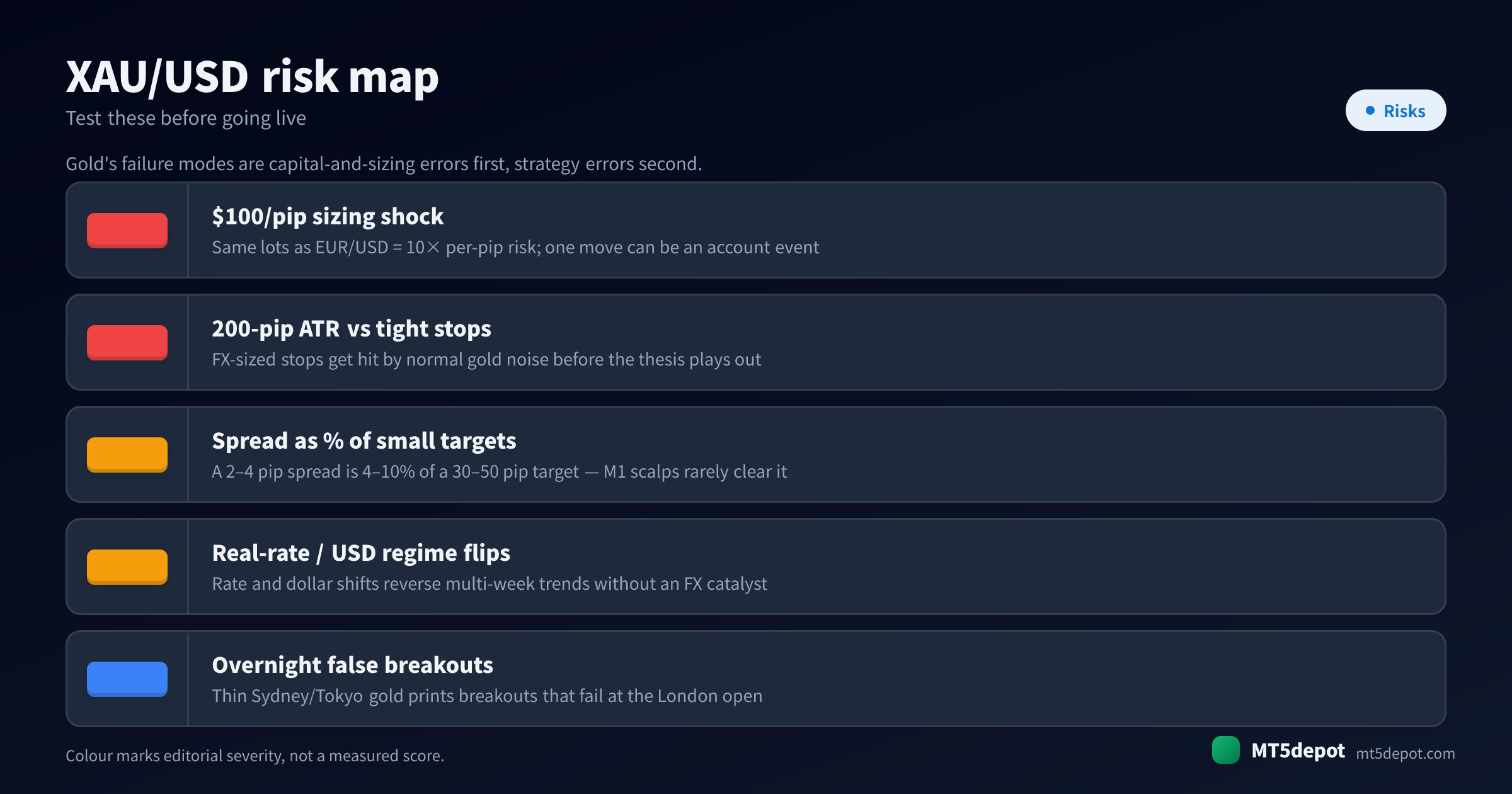
Gold’s failure modes are capital-and-sizing errors first, strategy errors second. A generic risk checklist misses most of them:
- The $100/pip sizing shock. Running gold at the same lot size as EUR/USD carries roughly ten times the per-pip risk. One normal gold move at forex lots can be an account-ending event, not a drawdown. It is the single most common way a gold EA blows up, and it happens before the strategy has done anything wrong. Re-size lots for gold’s per-pip value before anything else.
- A ~200-pip ATR against tight stops. An FX-sized fixed stop sits inside gold’s normal daily noise, so it gets hit before the thesis has room to play out. Re-size stops and targets to gold’s own ATR, not to a number carried over from a major.
- The spread as a percentage of small targets. A 2–4 pip spread is 4–10% of a 30–50 pip target. An M1 scalp on gold rarely earns back the cost of entry, which is why the table above rates it avoid.
- Real-rate and USD regime flips reverse trends without an FX catalyst. A shift in real interest rates or dollar strength can reverse a multi-week gold trend with nothing on the forex calendar to warn a price-only EA. A trend system with no volatility or regime filter can hold straight into the reversal. The same driver moves XAG/USD, so running gold and silver together stacks one macro position under two symbols instead of spreading the risk — and silver’s thinner liquidity widens its spread exactly when that shared driver moves both.
- Overnight false breakouts. Thin Sydney and Tokyo hours print breakouts that fail at the London open. An unfiltered breakout EA reading those moves trades noise, not a real level.
How to Test a XAU/USD EA
On gold, the test is the whole edge. Hold anything you build to the bar set out in the site’s methodology:
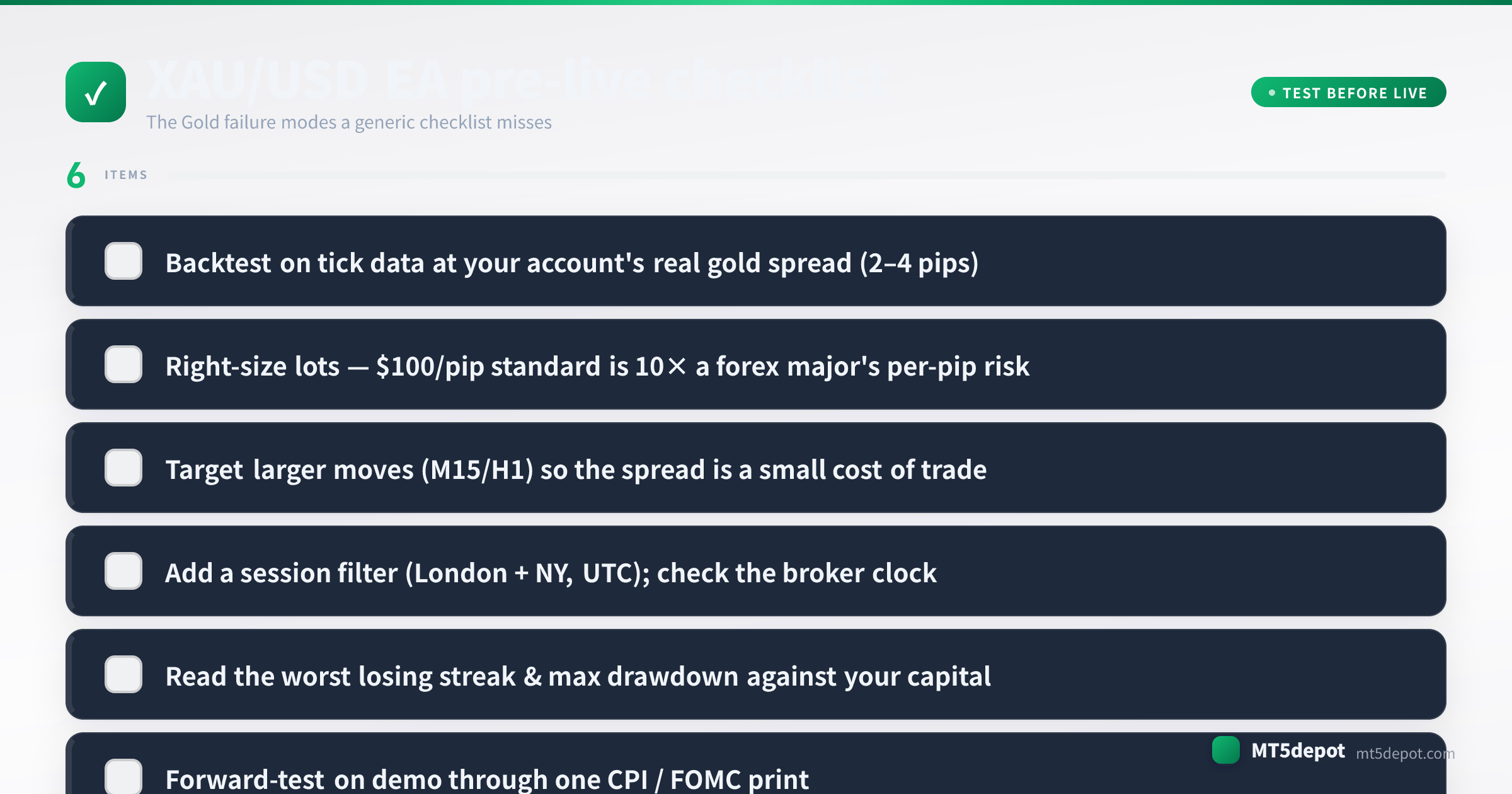
- Backtest on tick data at your account’s real gold spread. Use an every-tick model with the 2–4 pip standard or 1.5–2.5 pip raw spread you will actually trade, not the platform default. On gold the gap between a default spread and your real one is measured in real dollars, because of $100/pip.
- Right-size the lots, then read the worst losing streak. Confirm the per-pip value your lot size implies is one you can survive. Then read the max drawdown and the longest run of losing trades in account-currency terms, not pips — gold’s $100/pip turns a modest pip drawdown into a large capital one. Budget for the worst streak before you fund it.
- Forward-test on demo through at least one CPI or FOMC print. Gold’s defining risk shows up around a real-rate or dollar catalyst. A demo window that never spans one of those US prints has not tested the thing that matters most.
- Confirm the server clock before the first live trade. Re-check MT5’s Market Watch time against the UTC session hours above, and re-check it after any broker migration. Easy to skip, expensive to miss.
Every backtest number this produces is a historical measurement, not a forecast — size for the drawdown you measured, not the return you hope for.
XAU/USD EAs and Builder Templates
We have not published a gold backtest of our own, and a forex result does not carry over to gold’s $100/pip arithmetic. The honest route to a gold EA is to build and verify one:
- The Builder (open it here) accepts XAU/USD in its trend and breakout templates and exposes every parameter — crucially lot size. The EA you deploy is built on your own sizing arithmetic.
- Broker and account fit. Gold’s cost and per-pip value depend on the account. Check the spread and contract details on your own broker before you size anything.
- The concept canonicals. If a term above is unfamiliar, the volatility, ATR and leverage entries define the mechanics a gold EA depends on most.