Bitcoin is not a currency pair. It is a 24/7 macro-liquidity asset that happens to be quoted against the US dollar and traded here as a leveraged CFD. ETF flows, macro-liquidity conditions and a rising sensitivity to tech-risk sentiment — not an interest-rate differential between two economies — are what move BTC/USD. They move it in violent runs that dwarf anything a forex major produces. The first thing to decide is whether your strategy wants that character or merely tolerates it. A trend or breakout EA feeds on Bitcoin’s enormous range, while a system sized, stopped and scheduled for EUR/USD meets several times the volatility, a market that never closes, and a financing charge FX never taught it about. Pick the instrument to the strategy, not the other way round — and note that its nearest peer, ETH/USD, is more volatile still.
This page covers what Bitcoin gives an automated strategy that a forex pair does not, the liquidity windows that decide its results, and what it costs — including the CFD financing forex has no equivalent for. It then covers the failure modes that catch FX-built systems, and how to build and test a Bitcoin EA of your own.
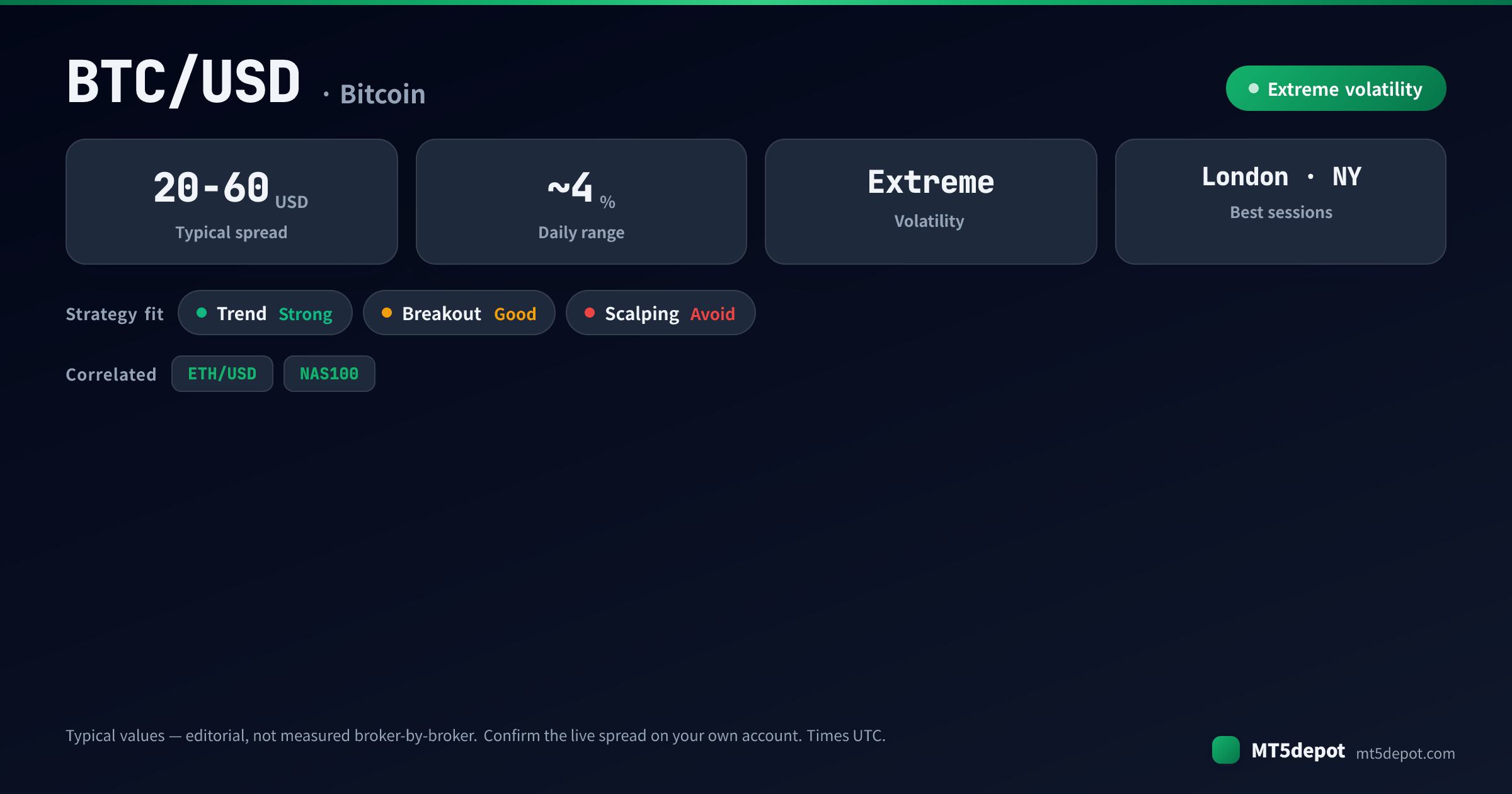
How BTC/USD Behaves: What Bitcoin Gives an EA
Bitcoin is structurally different from a forex major in ways that matter more for automation than any indicator choice. It never closes, its arithmetic is extreme, and it carries a financing cost the FX world an EA was probably designed for does not have.
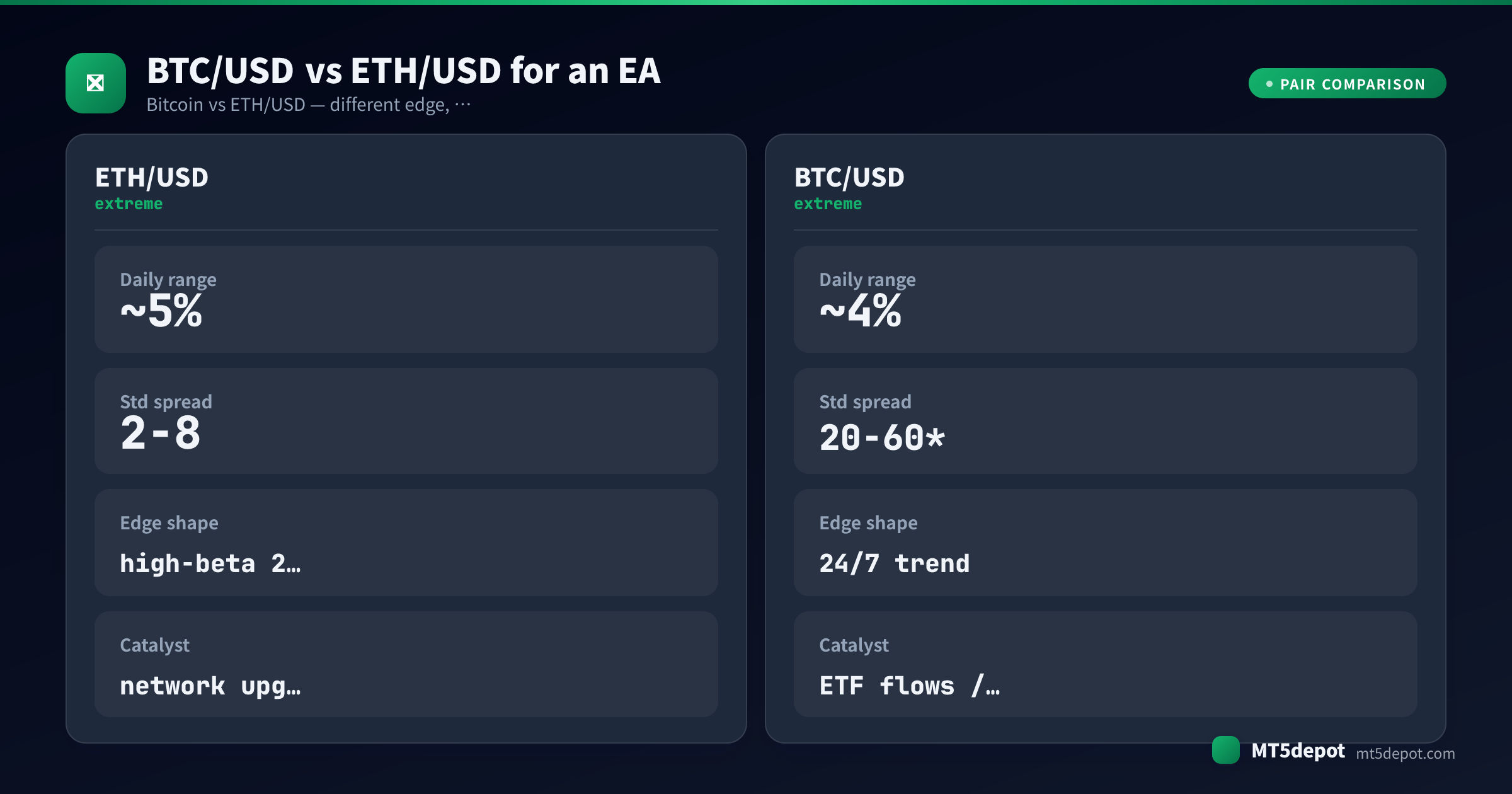
For an EA, that character reduces to three properties:
- An extreme range and a ~4% typical day. Our published typical daily range for Bitcoin is around 4% of price — labelled typical, not measured broker-by-broker — against well under 1% for a forex major. That range gives trend and breakout systems room to run, but a forex-scaled stop sits deep inside a single Bitcoin hour’s normal noise. Re-sizing stops and lots to Bitcoin’s own ATR is the fact everything else here follows from.
- A market that never closes. BTC/USD trades 24/7, through weekends and holidays, with no session bell. A forex EA is flat and safe over the weekend. A Bitcoin EA can be holding a leveraged position straight through a Saturday liquidity vacuum, where a shock moves price hard and a stop can gap far past its intended level before Monday depth returns. This is not a risk a forex system was ever built to carry.
- Risk-on, not a hedge. Bitcoin has increasingly moved with tech-risk sentiment — often tracking the Nasdaq rather than acting as the uncorrelated store of value its marketing implies. A trend EA reading price alone has no idea that its Bitcoin long and a long-equity position may now be the same bet expressed twice.
The trap for automated strategies is that Bitcoin’s large, clean-looking range reads as an easy edge on a backtest. That same range, plus 24/7 trading, weekend gaps and daily financing, turns one ordinary move into an account event if the lots were copied from a forex system. Bitcoin rewards strategies that respect its volatility regime and its sizing arithmetic, and quietly ruins ones that treat it as a forex pair with a bigger number.
Which EA Strategies Suit BTC/USD?
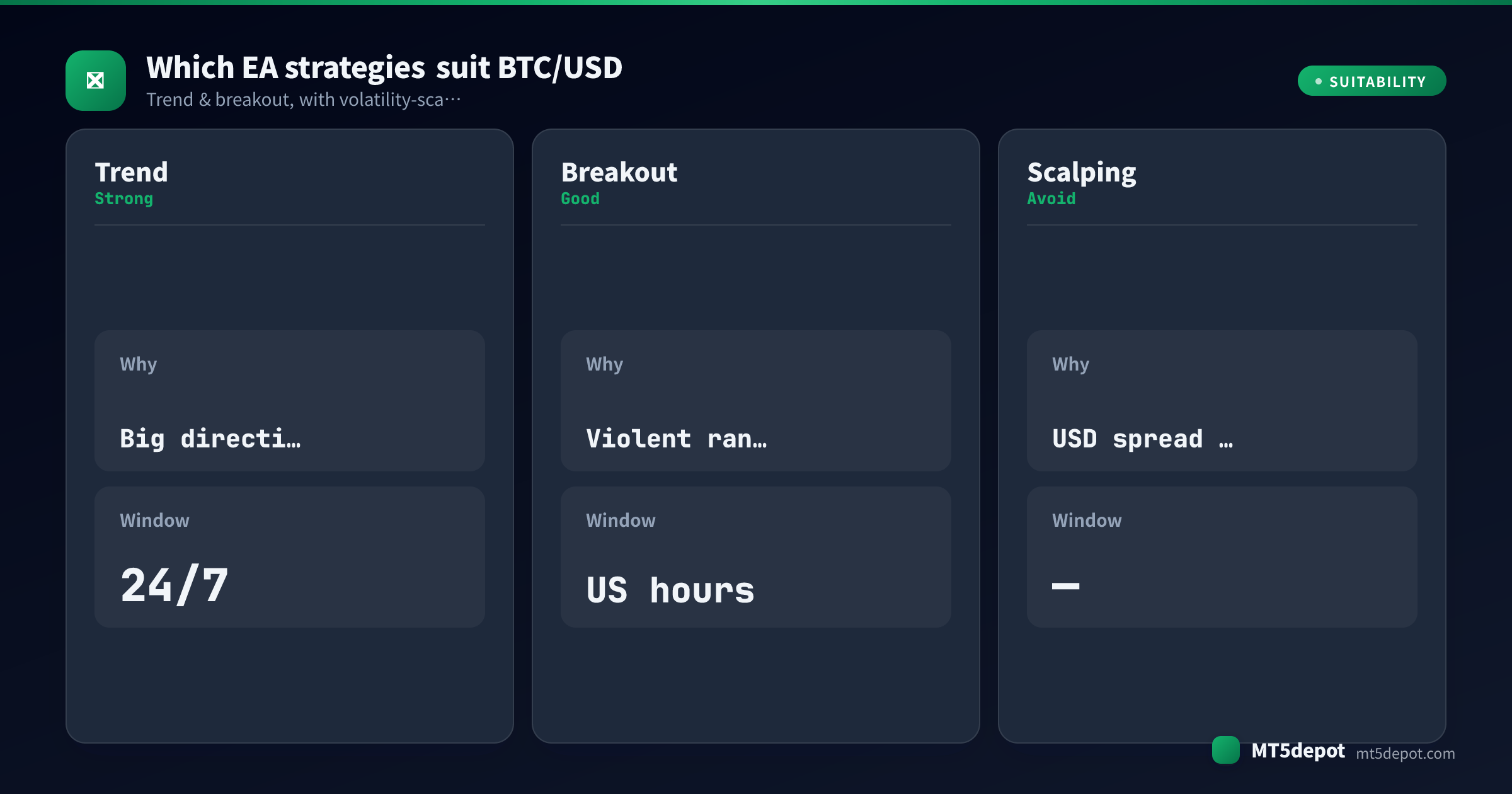
The instrument’s profile lists trend and breakout as suitable — but suitability is an editorial assessment, not proof. In our own stock-settings baseline of the Builder’s templates — a single USD/JPY M5 run over one year, default inputs, no optimisation — most finished below a 1.0 profit factor, and that run was not on Bitcoin. Almost none cleared the Builder’s own bar at stock settings, so treat any edge on Bitcoin as something your own settings and test have to earn. Look for it in mechanics — sizing discipline, session windows, pending-order entries — not the indicator on the box. What Bitcoin’s character tends to support:
| Strategy | Fit on BTC/USD | Why |
|---|---|---|
| Trend | Strong | Bitcoin’s big directional runs suit momentum systems — the ~4% range gives a 2:1 or 3:1 target real room to fill, provided the lot is scaled to that range rather than to a forex pair. |
| Breakout | Good | The violent ranges around the US hours give an objective level to break, and pending-order entries at the range edge reduce the spread cost a market fill pays on a wide, USD-quoted spread. |
| Scalping | Avoid | A 20–60 USD spread is a large share of any small target, and it widens hardest off-hours and on weekends where a fast EA concentrates trades — the cost math rarely clears on Bitcoin. |
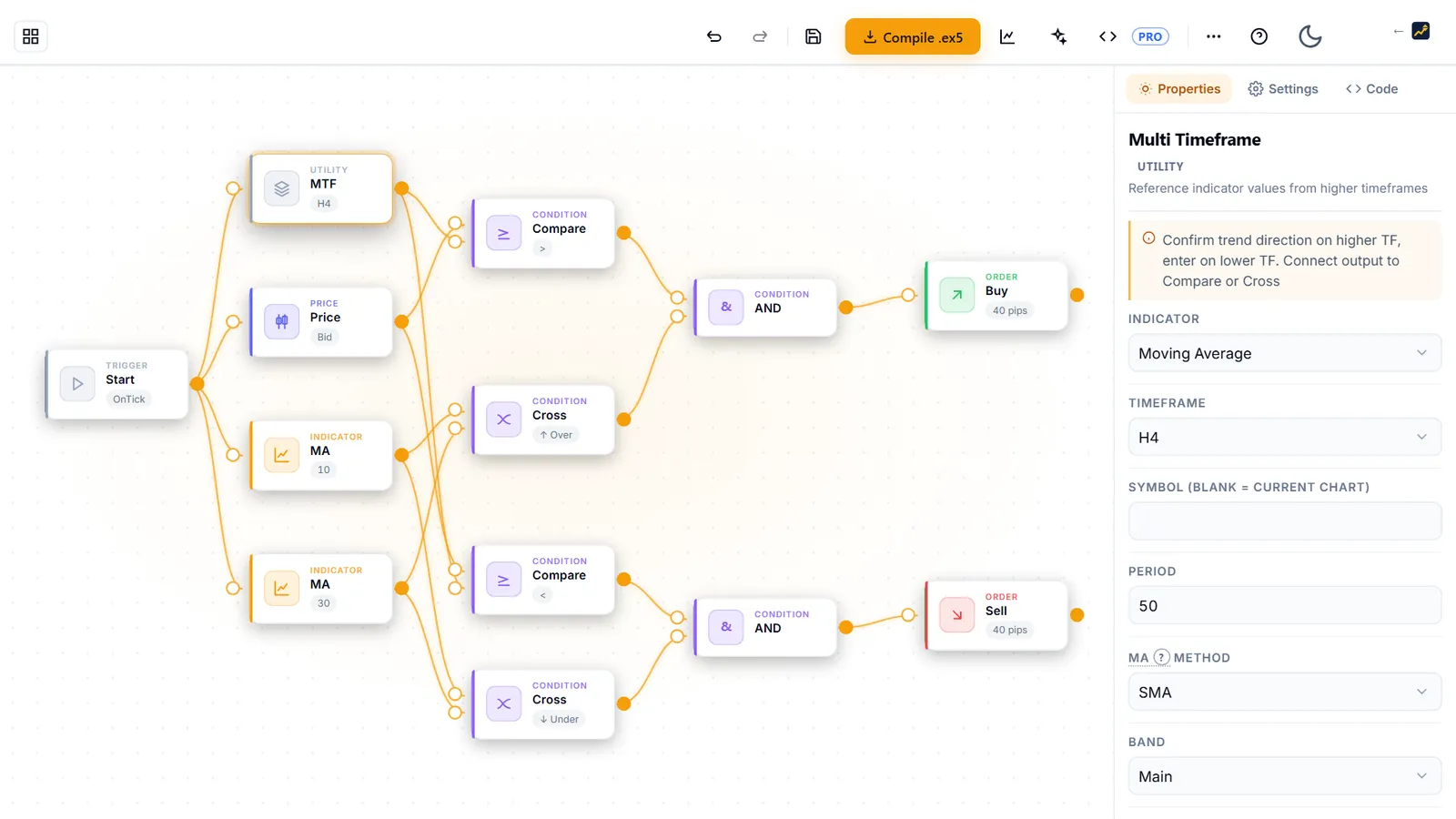
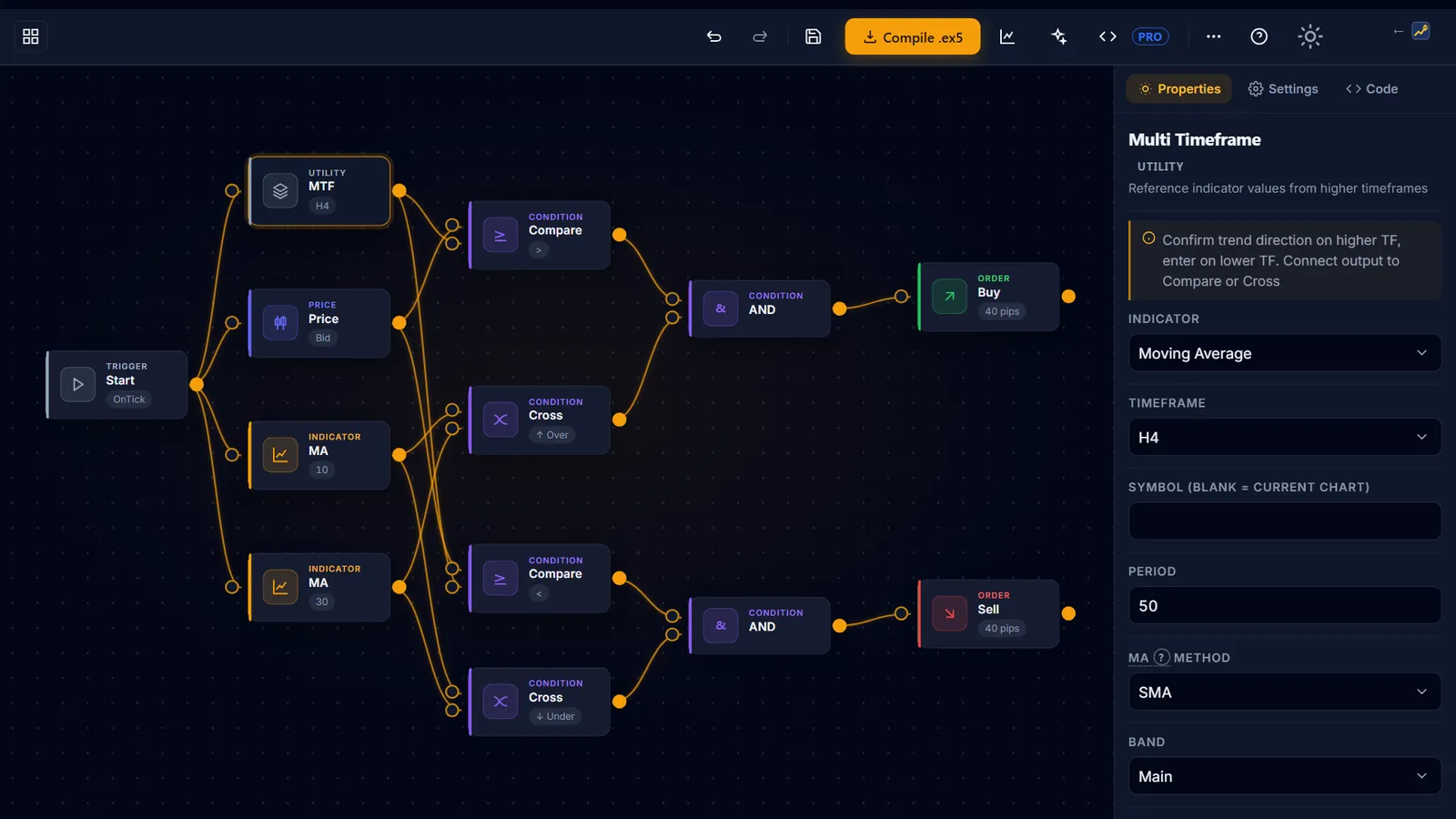
Trend and breakout are the shapes that turn Bitcoin’s range into an asset. The practical route is to build one of these shapes yourself. The Builder ships templates that accept BTC/USD and exposes every parameter, including lot size — then test it (below) before you trust a single number.
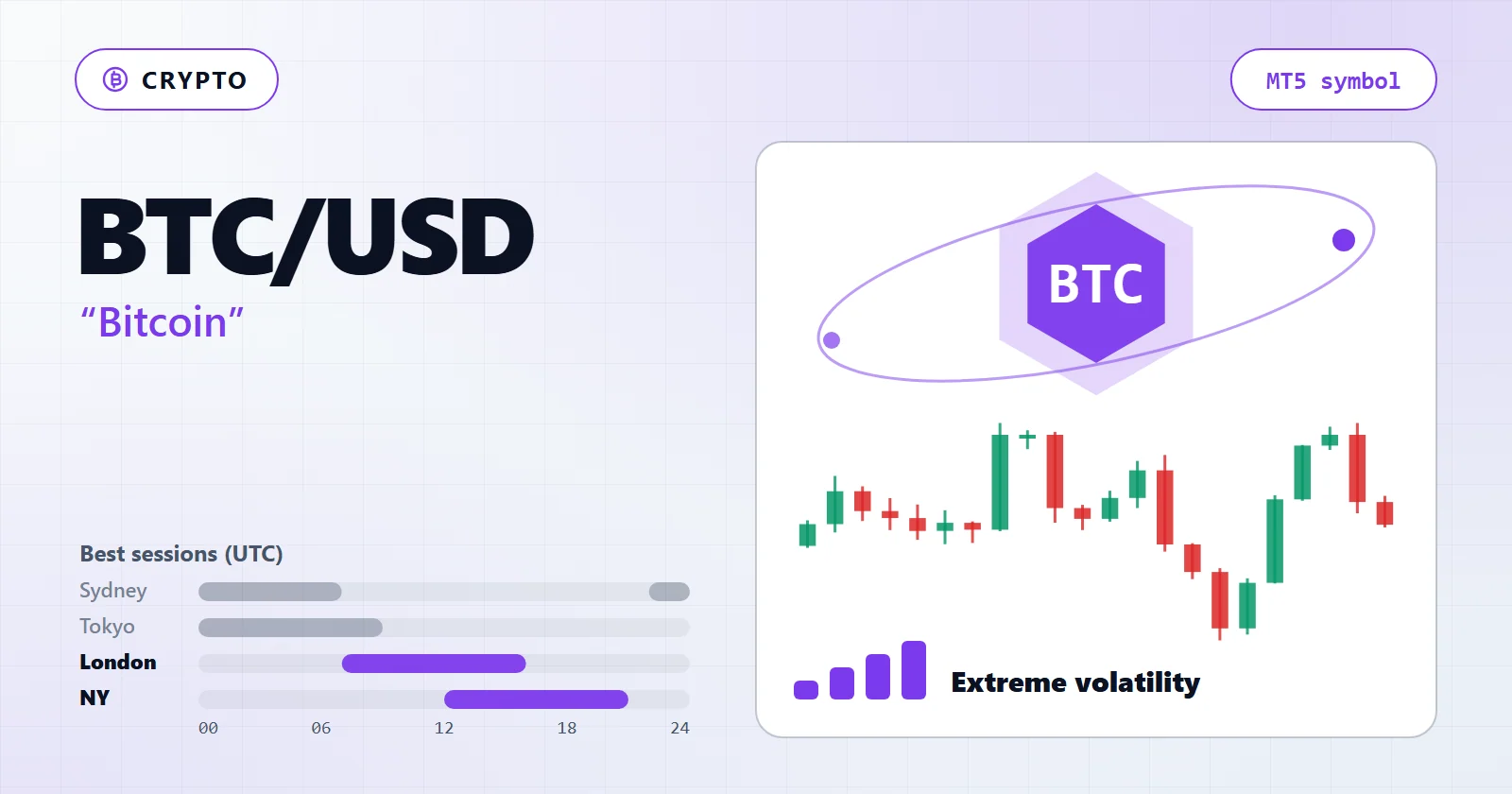
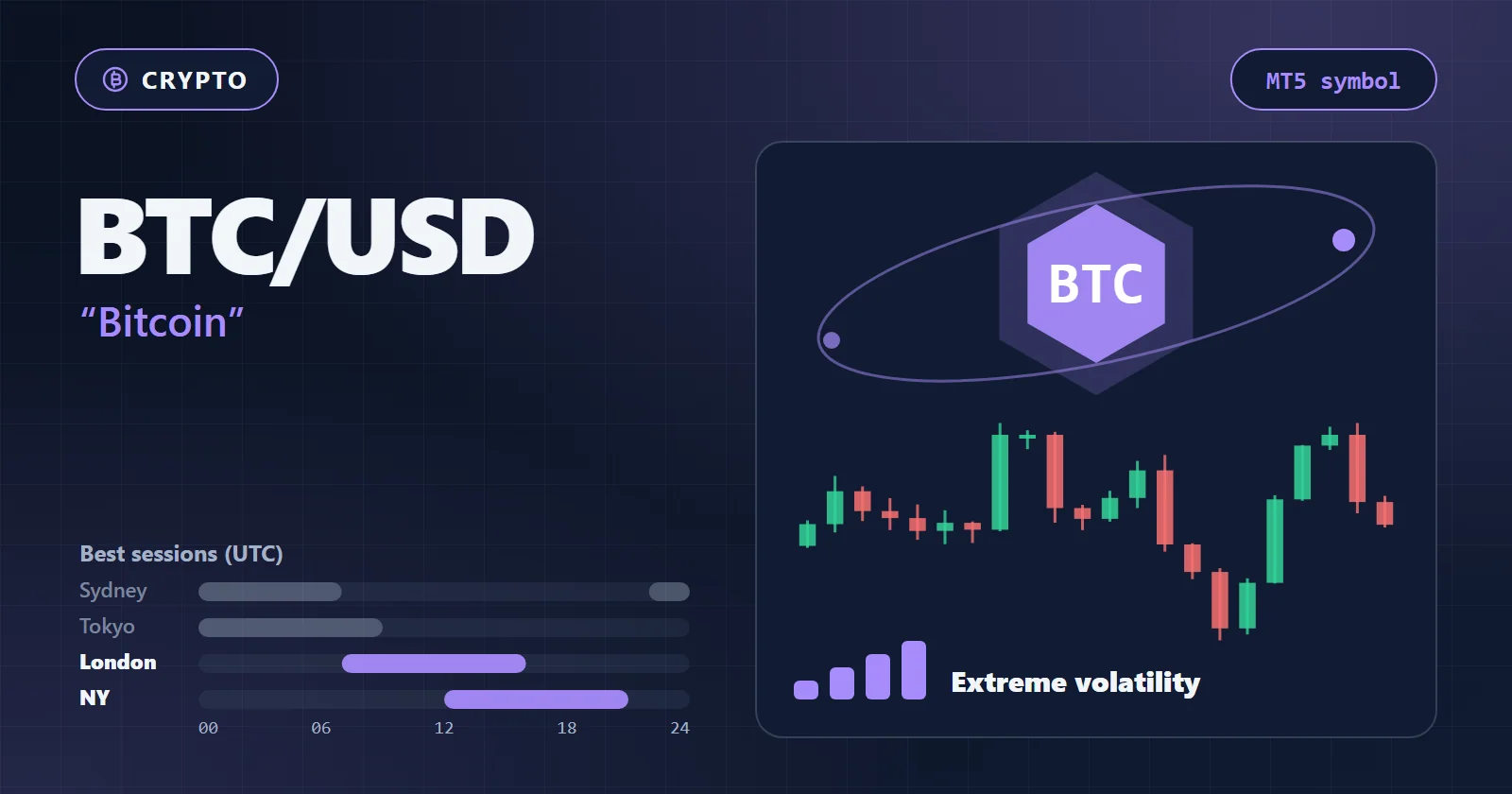
Best Trading Hours for BTC/USD EAs
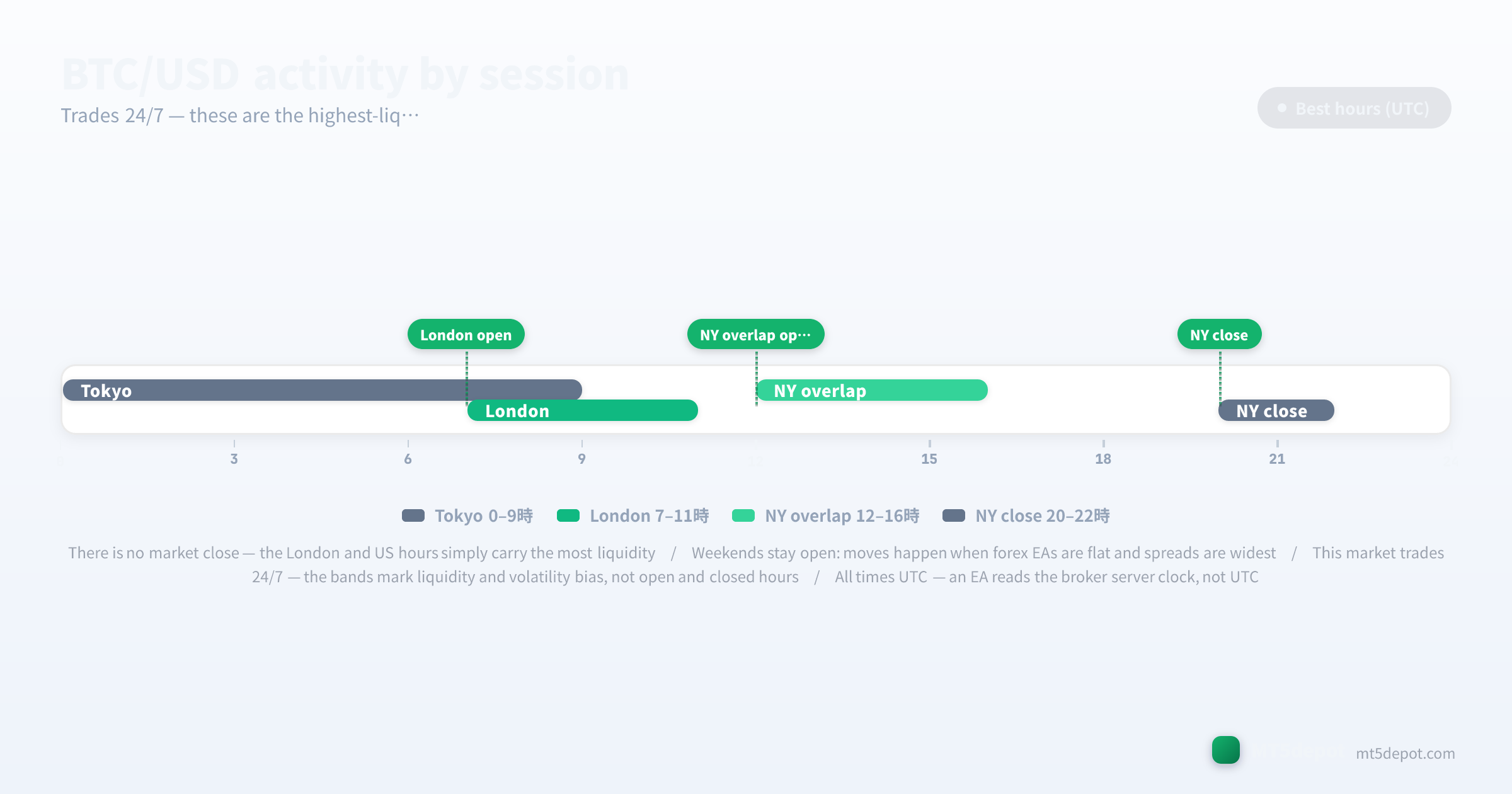
Bitcoin has no session bell; the market itself never closes. “Best hours” here means the windows of deepest liquidity and tightest spread, not the difference between open and shut:
- Asian hours (roughly 00:00–07:00 UTC): active but thinner, with wider spreads and lower conviction. Breakouts printed here often fail once European and US depth arrives.
- London hours (roughly 07:00–16:00 UTC): liquidity deepens and spreads tighten as European flow joins; trend and breakout EAs tend to find cleaner entries here than overnight.
- US overlap (roughly 12:00–20:00 UTC): the most active stretch — US risk sentiment, ETF flow and equity-market correlation are strongest here, which is often where Bitcoin’s biggest directional moves resolve.
- Overnight and weekends: the market stays open, but depth drains, spreads widen most, and price can gap on thin flow. A fast EA that keeps trading through these hours concentrates its activity exactly when execution is worst.
Two cautions come with this. First, because Bitcoin never closes, it moves through the weekend when your forex EAs are flat. A Bitcoin EA therefore needs an explicit weekend and off-hours policy — pause, tighten, or size down — rather than the implicit weekend safety a forex system inherits from the market itself. Second, every clock time above is UTC. An EA reads your broker’s server clock, which is usually not UTC, so a “12:00” filter shifts silently when you move the EA between brokers on different server timezones. Verify it once in MT5’s Market Watch, and every window boundary lines up. The market not closing does not exempt you from the clock — it makes the off-hours filter matter more.
Spreads, Costs, and Execution
Bitcoin’s cost structure has a component forex does not: a leveraged crypto CFD accrues a daily financing (swap) charge for holding overnight. On a volatile, higher-carry instrument that charge is materially larger than a forex swap. The figures below are editorial reference ranges compiled from broker-published crypto-CFD conditions (updated July 2026), quoted in US dollars rather than forex pips, with daily range as a percentage — not broker-by-broker measured numbers. Our live spread sampling currently covers a few FX reference symbols. Confirm the live spread and the financing rate on your own account before you size a fast strategy:
| Cost component | Typical BTC/USD figure | Notes |
|---|---|---|
| Spread (liquid hours) | 20 – 60 USD | widens sharply off-hours and on weekends |
| Commission | account-dependent | a property of your account type, not of Bitcoin |
| Daily financing / swap | charged per night held | far larger than a forex swap; compounds on multi-day trends |
Two cost rules specific to this instrument:
- The spread is a dollar figure that moves, not a fixed pip. A 20–60 USD spread in liquid hours is a small fraction of a large trend trade but a large slice of any small target. It does not stay put: it widens most in the overnight and weekend hours where depth is thinnest. A Bitcoin scalper validated on a liquid-hours average and deployed into a weekend spread is running a different, more expensive strategy than the one it tested.
- Financing is a cost of time, and it turns a winning trend into a smaller one. A leveraged Bitcoin CFD held for days pays financing every night, so a slow trend EA a forex cost model would call cheap can be quietly expensive here. Model the overnight financing explicitly in any hold-longer strategy — a forex-shaped backtest omits it entirely.
Risks to Test Before Going Live
Bitcoin’s failure modes are capital-and-structure errors first, strategy errors second, and a generic risk checklist misses most of them:
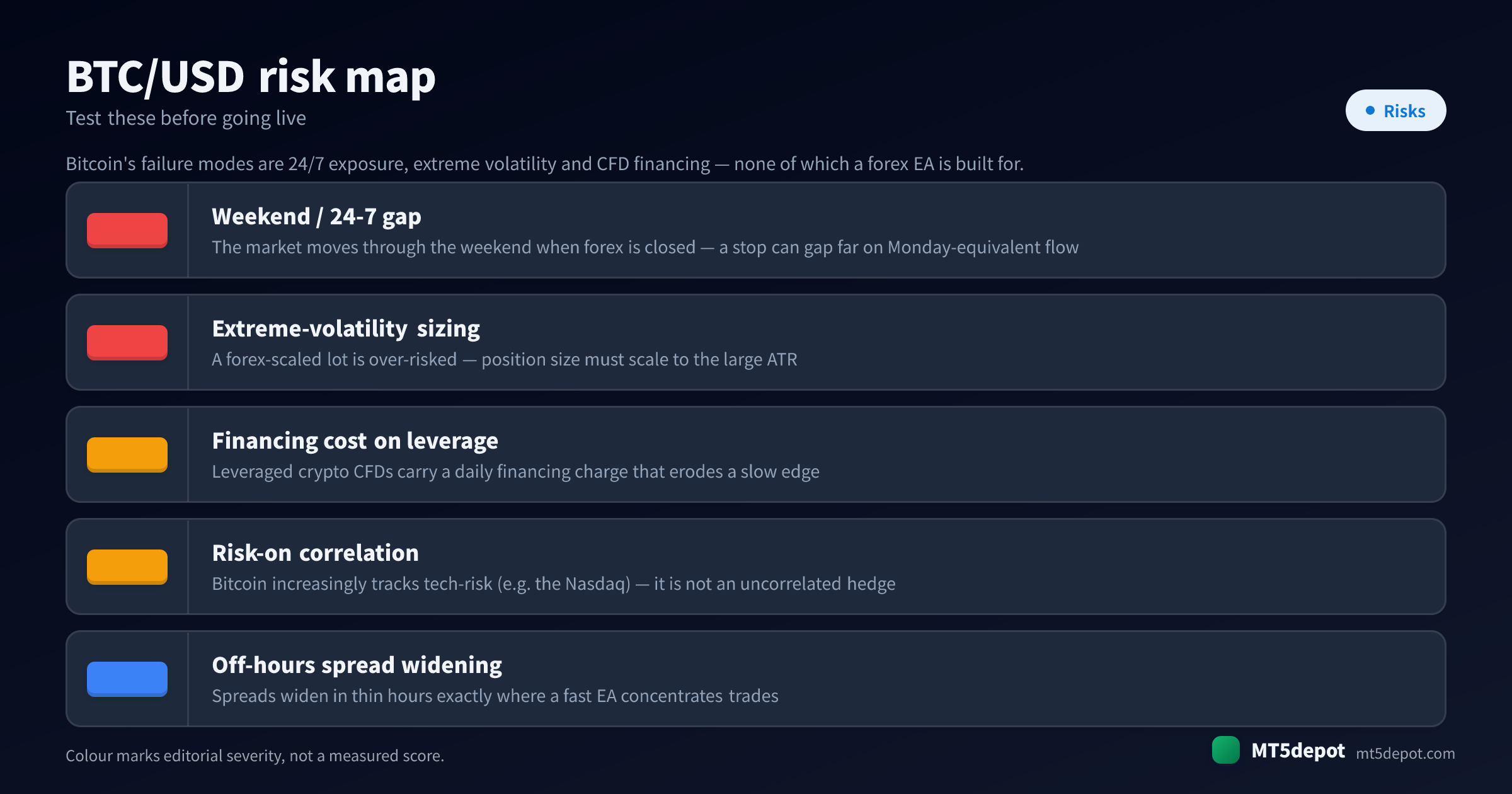
- The weekend-gap trap a forex EA never faces. A forex robot is flat over the weekend by default. A Bitcoin EA can hold a leveraged position straight through a Saturday liquidity vacuum, where a shock gaps price far past a stop before Monday depth returns. Test what your strategy does over a full weekend, and give it an explicit weekend policy rather than assuming the market close that Bitcoin does not have.
- Forex-scaled lots are over-risked on a ~4% range. Copying a EUR/USD EA’s lot size onto Bitcoin ignores that one ordinary Bitcoin day is several normal forex days of movement. A forex-sized lot carries far more per-move risk here, so one normal Bitcoin swing at forex lots can be an account event, not a drawdown. Re-size lots and stops to Bitcoin’s own ATR before anything else — this is the single most common way a crypto EA blows up.
- Daily financing on a leveraged CFD erodes slow strategies. Every night a leveraged Bitcoin position is held, it pays a financing charge larger than any forex swap. A hold-longer trend EA can hand back a real share of its edge to carry that a forex-shaped backtest never modelled. Budget the financing before you trust the profit factor.
- The Nasdaq correlation makes it a doubled bet, not a hedge. Because Bitcoin increasingly tracks tech-risk sentiment, a Bitcoin long and an equity or tech position can be the same exposure twice over. The correlation is hidden leverage that appears in neither position’s risk settings. Test the assumption that BTC/USD diversifies your book; recently it often has not. The same arithmetic applies inside crypto: XRP/USD and the other digital assets covered on this site move largely with Bitcoin’s own risk cycle, so a BTC-plus-alt book is closer to one crypto position at larger size than to a diversified one.
- Off-hours spread widening ambushes fast systems. The 20–60 USD spread balloons overnight and on weekends, exactly when a high-frequency EA concentrates its trades. A scalper that looks profitable on liquid-hours data can bleed the whole edge in the off-hours the backtest averaged over. Validate on data that includes the wide-spread windows, not just the deep ones.
How to Test a BTC/USD EA
On Bitcoin, the test is the whole edge. Hold anything you build to the bar set out in the site’s methodology:
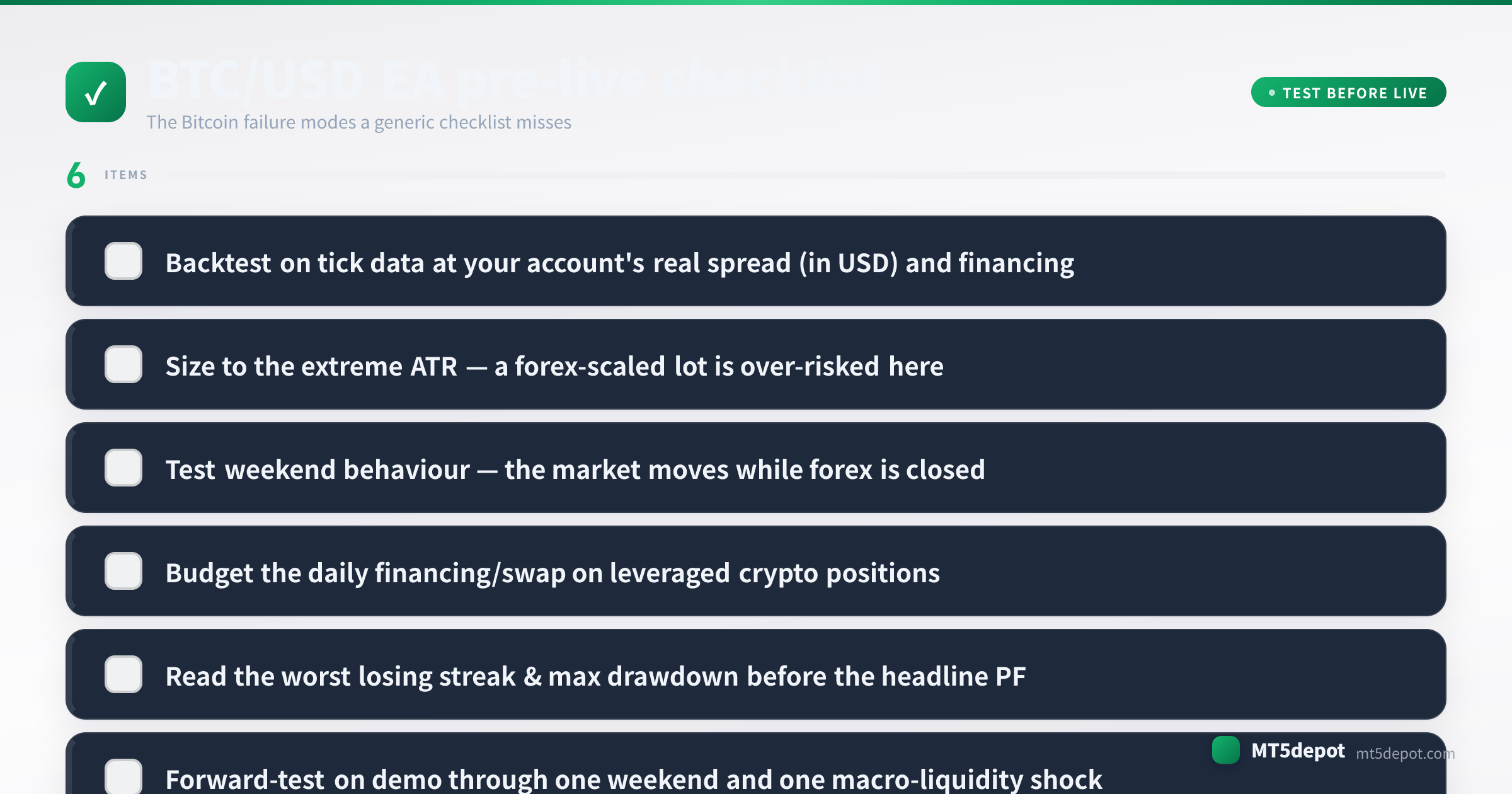
- Backtest on tick data at your account’s real spread, including the off-hours. Use an every-tick model with the 20–60 USD spread you will actually trade. Make sure the data spans the overnight and weekend windows where the spread widens, not just the liquid hours — on Bitcoin the widest spreads are exactly the ones a fast system trades through.
- Model the financing, then read the worst losing streak. Include the daily financing charge in the test so a hold-longer trend is judged on its net result. Then read the max drawdown and the longest run of losing trades in account-currency terms — Bitcoin’s extreme range turns a modest percentage drawdown into a large capital one. Budget for the worst streak before you fund it.
- Forward-test on demo through at least one full weekend and one macro catalyst. Bitcoin’s defining risks — the weekend gap and the risk-on correlation — only show up around a weekend or a macro/ETF-flow event. A demo window that never spans one has not tested the things that matter most.
- Confirm the server clock before the first live trade. Re-check MT5’s Market Watch time against the UTC windows above, and re-check it after any broker migration. Easy to skip, expensive to miss on an instrument whose off-hours filter carries real weight.
Every backtest number this produces is a historical measurement, not a forecast — size for the drawdown you measured, not the return you hope for.
BTC/USD EAs and Builder Templates
We have not published a Bitcoin backtest of our own, and a forex result does not carry over to a market that trades through the weekend and charges financing every night. The honest route to a Bitcoin EA is to build and verify one:
- The Builder (open it here) accepts BTC/USD in its trend and breakout templates and exposes every parameter — crucially lot size. The EA you deploy is built on your own volatility-scaled sizing and your own weekend policy.
- Broker and account fit. Bitcoin’s spread, financing charge and contract details depend on the account. Check them on your own broker before you size anything.
- The concept canonicals. If a term above is unfamiliar, the volatility, ATR and leverage entries define the mechanics a Bitcoin EA depends on most.