The usual version of this comparison is about judgement: a person reads context, an expert advisor reads a rule set. That framing is not wrong, but it is not measurable, and it hides the difference that actually decides outcomes. An EA follows its rules through a losing run. A person decides, in the middle of that run, whether the rules still apply.
We can measure the second half of that sentence on our own data.
But it depends on:
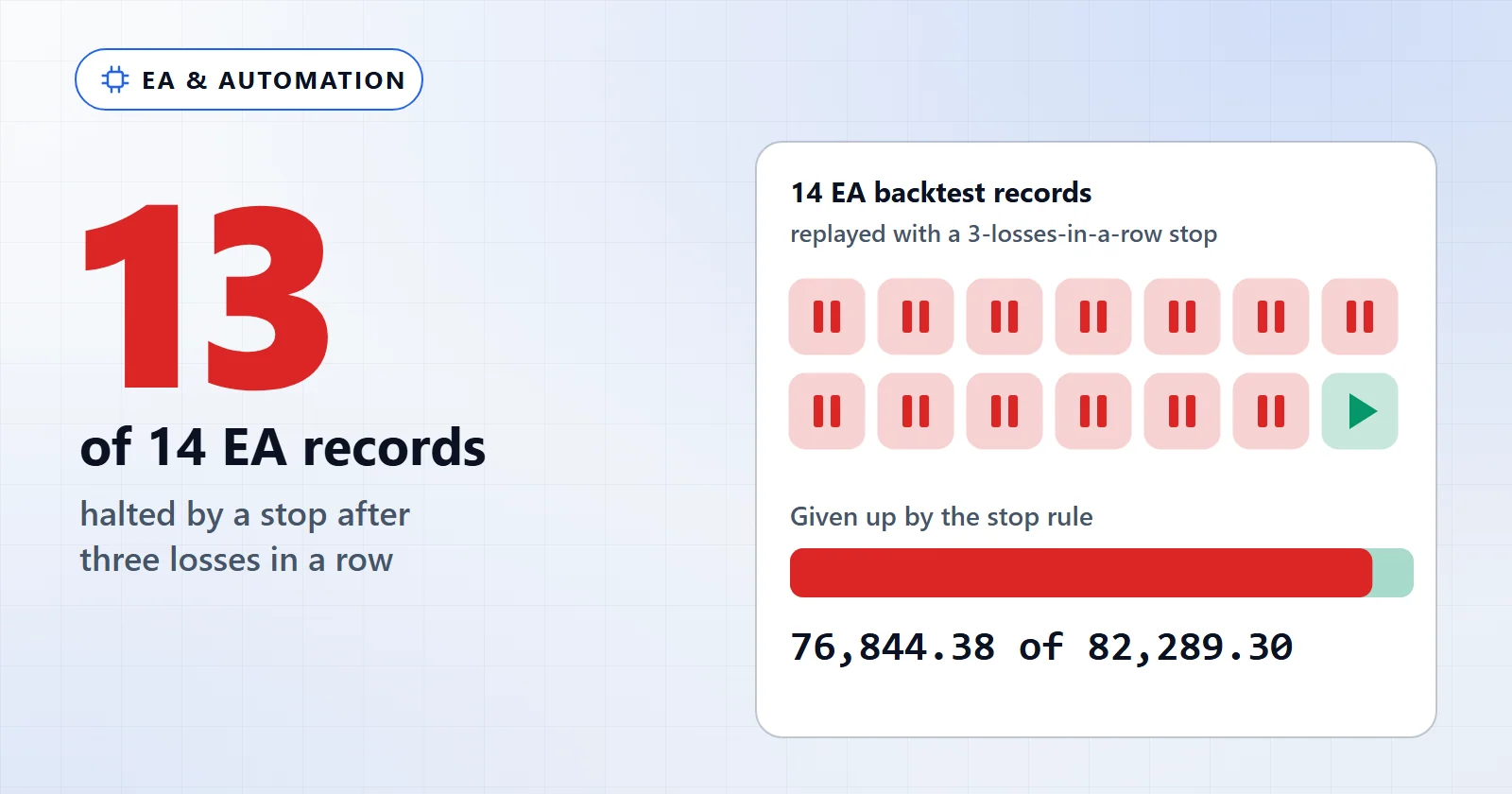
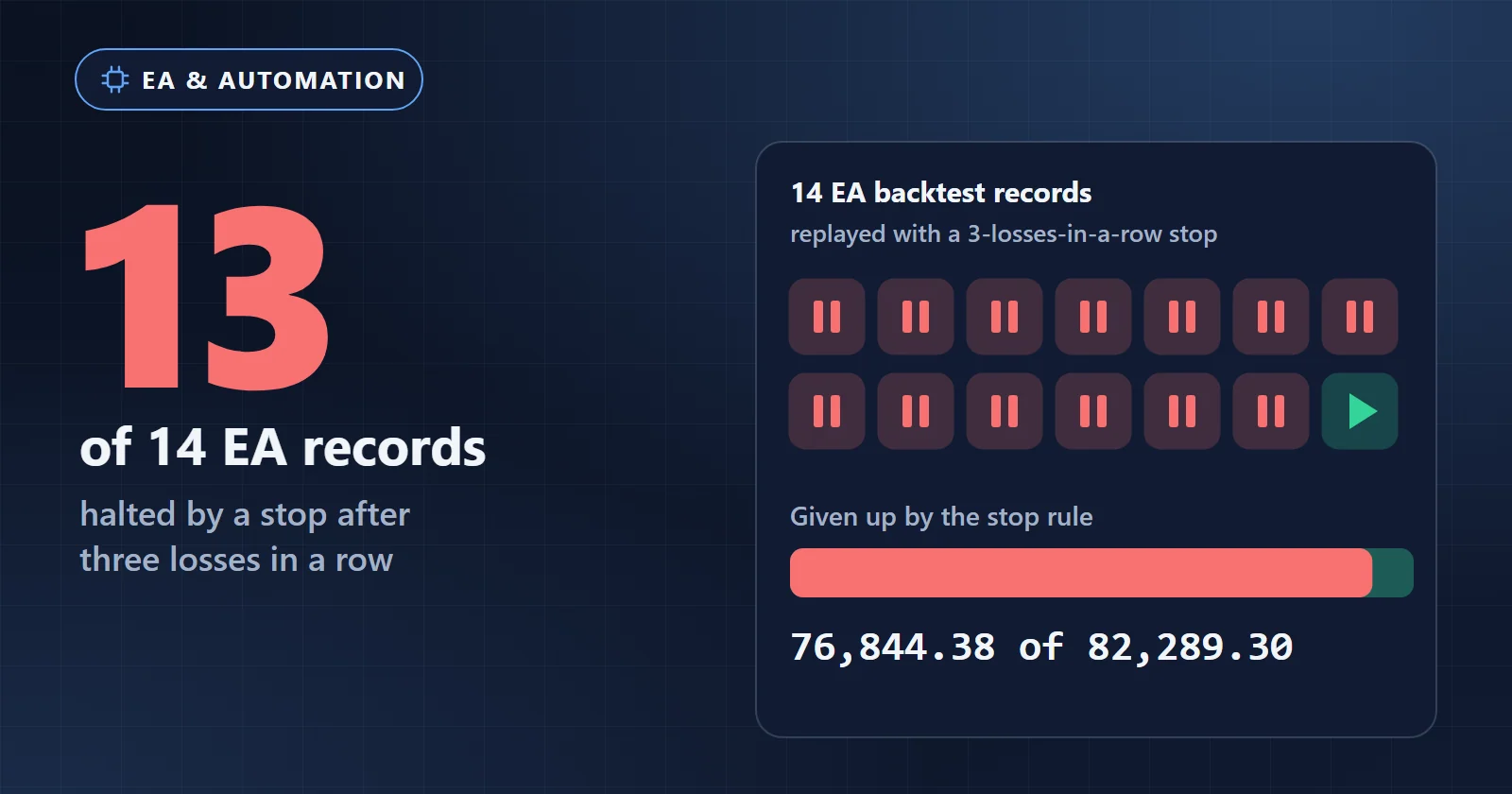
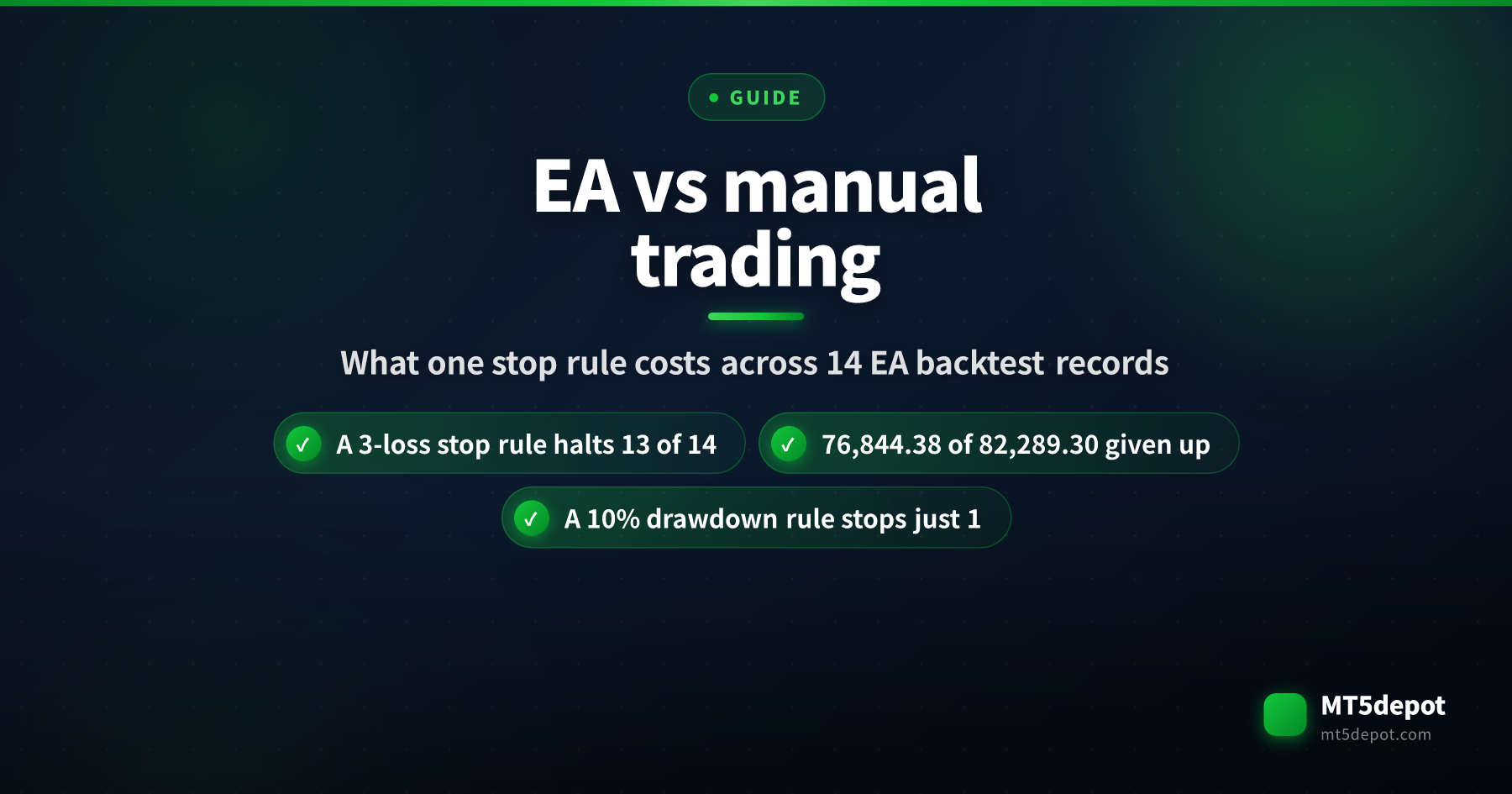
- Which rule you intervene by. A 3-loss rule stops 13 of 14 records. A 10% drawdown rule stops 1.
- When the losing run arrives. Four records are switched off while still in a loss, before their edge ever appears.
- Whether the rule set had an edge at all. Sitting still only pays when the rules were worth following; on a rule with no edge, interruption is cheap.
- Whether the two are even separable. Most people who “trade manually” also run something automated, and the failure mode is the interaction between them.
Each of those is tested against our own data below.
What the data shows: the price of switching off
The 14 records are MT5 Strategy Tester backtests of rule-based EAs, one chart and timeframe each, every one with its complete closed-trade list. Three of them trade several symbols from that one chart. Replaying those lists in order and applying a stop rule — switching off for good the moment the rule fires, because someone who quits after a bad run rarely restarts at the bottom — gives the cost of each intervention style.
| Stop rule | Records switched off | Left sitting in a loss | Result given up | Median per record |
|---|---|---|---|---|
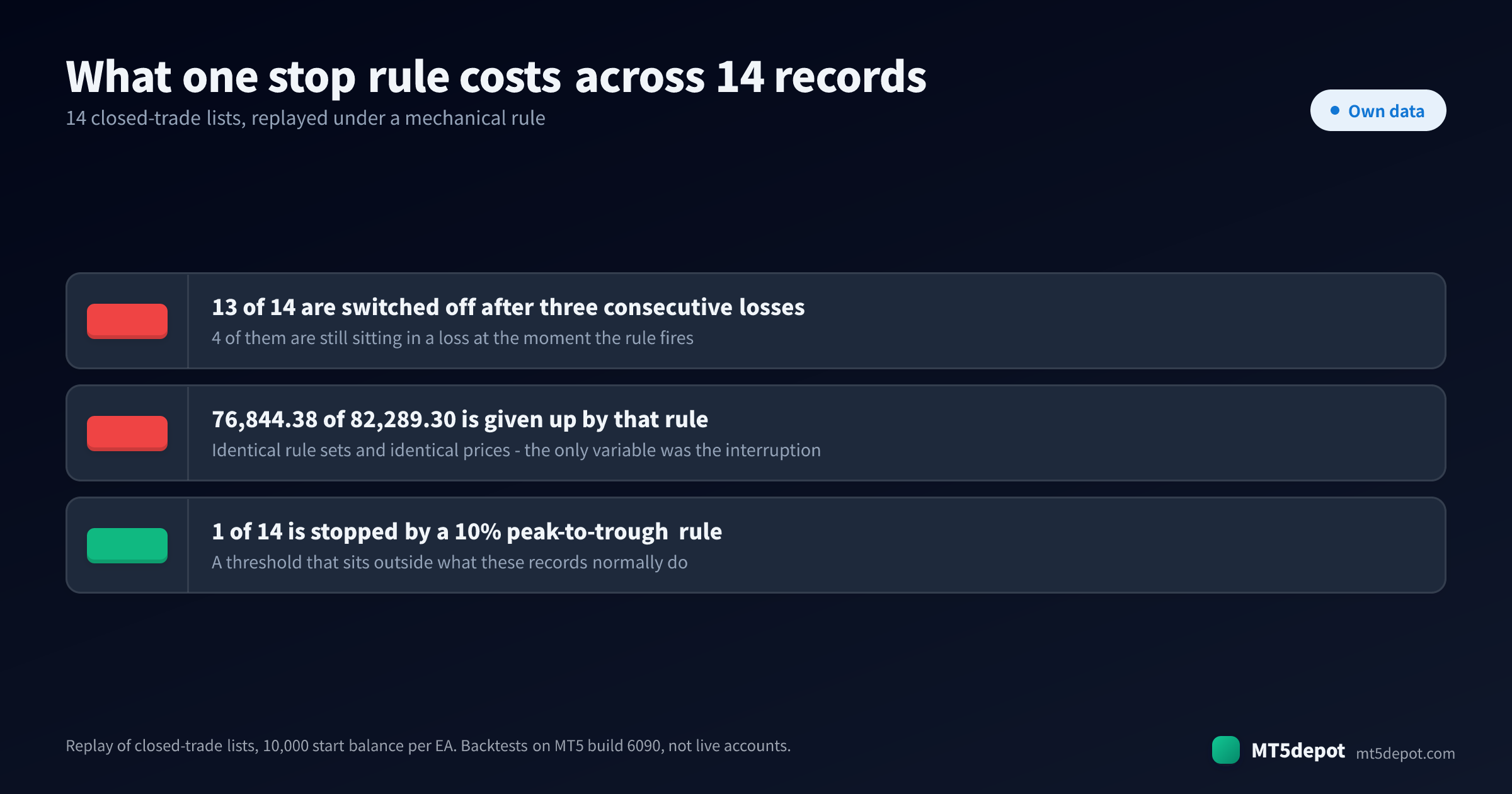
| After 3 consecutive losses | 13 of 14 | 4 | 76,844.38 | 3,376.31 |
| After 5 consecutive losses | 7 of 14 | 3 | 63,717.06 | 1,713.32 |
| After 8 consecutive losses | 7 of 14 | 2 | 55,615.69 | 596.26 |
| Closed-trade balance 5% below its peak | 10 of 14 | 4 | 68,346.36 | 2,855.88 |
| Closed-trade balance 10% below its peak | 1 of 14 | 0 | 27,532.12 | 0 |
| Test conditions | |
|---|---|
| Experiment ID | EXP-INTERVENTION-COST-001 |
| MT5 build | 6090 |
| Environment | Replay of closed-trade lists from MT5 Strategy Tester runs, 10,000 start balance per record |
| Symbol / timeframe | One chart and timeframe per record; three records trade several symbols |
| Period | 2019-01-01 – 2026-08-09, per-record windows vary |
| Model | Every tick generated from M1 bars (12 records); every tick based on real ticks (2 records) |
| Last verified | 2026-08-14 |
The replay script and the per-record rows are stored with experiment EXP-INTERVENTION-COST-001, together with the totals every line above is taken from. How we run and label these tests is set out in our testing methodology.
Two things in that table matter more than the totals.
A tight stop rule fires early, not at the bottom. Under the 5-loss rule, a five-symbol H1 record (mostly EUR/USD) is switched off on 2019-01-14 — two weeks into a run that goes on to produce 9,403.46 — and the replay ends at -3.12. A seven-symbol H1 record stops on 2019-07-23 with 5.73 instead of 10,280.42. A USD/JPY H1 record ends at -214.58 instead of 3,212.05. The losing streak that triggers the decision usually arrives before the edge has had room to show up at all.
A loose rule barely fires. The 10% drawdown rule stops exactly one record — the only one whose closed-trade balance fell more than 10% below its peak — and leaves the other thirteen untouched. The replay measures drawdown on closed trades; floating equity runs deeper, so a live equity stop at 10% would fire on more of them. That is the difference between a threshold picked from a record and one picked because the number felt safe.
Seven of the fourteen never hit five consecutive losses at all, and run to the end of their records under the 5- and 8-loss rules. Whether an intervention rule costs you anything depends on which EA you attached it to — which is an argument for reading the record first, not for never intervening.
This is a replay of an owned record under a mechanical rule. It is not a live manual-trading record, and it does not measure discretionary skill — we do not have that data, and inventing it would be worse than not having it. What it measures is narrower and more useful: the cost of the specific reaction that separates the two approaches in practice.
EA vs manual: where the two actually differ
| Expert advisor | Discretionary trading | |
|---|---|---|
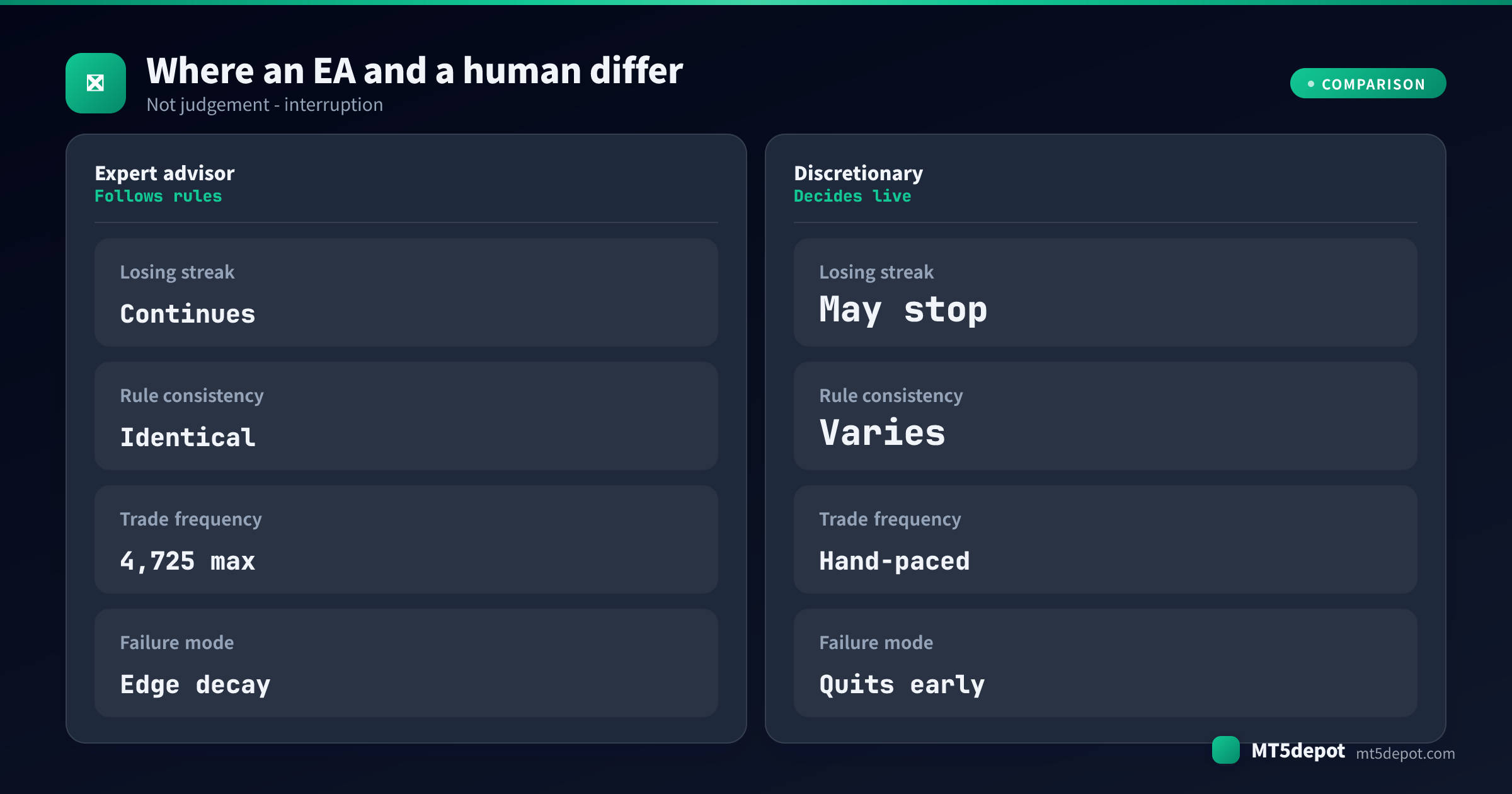
| Rule consistency | Identical on trade 1 and trade 400 | Varies with the last three outcomes |
| Reaction to a losing streak | Continues; the streak is in the record | Decides in the moment — the measurable gap above |
| Execution speed | Sub-second, on every signal | Limited by attention and screen time |
| Trade frequency it can sustain | 4,725 closed trades in one of these records | Not reproducible by hand at that rate |
| Context it can read | Only what is coded | News, regime change, anything visible |
| Failure mode | Keeps applying a rule set after it stops working | Abandons a rule set that still works |
| Where the record lives | Every trade logged, inspectable, recomputable | Usually reconstructed after the fact |
The two failure modes in that table are mirror images, and both are real. An EA has no idea its edge has decayed; it will keep placing trades with the same confidence it had in 2021. A discretionary operator notices decay quickly — and also “notices” it during ordinary losing streaks that are inside the documented behaviour. One error is expensive because it is slow; the other is expensive because it is fast.
Frequency is the other honest divide. The busiest record here contains 4,725 closed trades over roughly five years. Nobody executes that by hand with consistent sizing at consistent moments, so for strategies that live at that frequency the comparison is not “which is better” but “which is possible”.
What to look for when deciding between them
1. The streak you can actually sit through. Take it from the record, not from imagination. Seven of the fourteen records contain a run of at least eight consecutive losses. If a run of 8 losses would make you intervene, and your chosen EA’s record contains one, you will intervene — and the replay above shows what that costs. Worst streak is the number to check before the profit factor.
2. A stop threshold that sits outside normal behaviour. The 10% drawdown rule works on these records precisely because thirteen of fourteen never reach it. A threshold inside the EA’s documented max drawdown is not a safety rule; it is a scheduled exit at the worst moment.
3. Whether the rule set has an edge worth waiting for. The whole cost above assumes the rules were profitable when left alone. Most standard designs are not: of 53 Builder templates measured under one identical test, 42 ended below a profit factor of 1. Are expert advisors profitable shows what that looks like. Discipline applied to a losing rule only loses more consistently.
4. Whether you want to change rules or only follow them. If your edge is reading context that no rule set captures, automating it removes the edge. If your edge is a rule you already trust and cannot execute consistently, automating it is the whole point.
Running both in practice
Most people end up doing both, and that is where the avoidable damage happens.
- Separate the accounts, or at least the accounting. An EA sizes positions against the balance it can see. A discretionary position that ties up margin silently changes the size of every automated trade after it, so the EA stops reproducing the record you chose it for.
- Give the EA its own magic number — the
MagicNumberinput in the EA’s properties dialog — so that manual closes never touch its positions, and read the Experts tab of the Toolbox rather than the chart when you want to know what it decided and why. If two EAs share one number, each can manage the other’s trades. - Know which switch you just used.
Tools > Options > Expert Advisors > Allow Algo Tradingis the terminal-wide setting; the Algo Trading toolbar button is the session one. Turning the second off pauses new entries and leaves open positions running, which is a different decision from closing the account down — and the replay above prices the second one. - Write the intervention rule down before you start — a specific drawdown percentage taken from the EA’s record, or a specific behavioural break such as a trade frequency that stops matching the documented rate. A rule invented during a losing run is a decision made at the worst possible moment.
- Decide what a manual override means. Turning Algo Trading off for a news release is a rule if you wrote it down beforehand and a reaction if you did not. Only the first one is repeatable, and only the first one can be evaluated afterwards.
If you want to change what the automated side does rather than only when it runs, the Builder is where the rule set is editable, because rewriting a condition is a different act from overriding it live.
Risk and drawdown reality
Three limits belong with the numbers:
A replay is not a person. The stop rules modelled here are mechanical and terminal. A real operator might restart, halve the size, or move to another instrument. Treating “switch off” as permanent gives an upper bound on the cost of that reaction, not an average of what humans do.
Backtests bound the past. These are strategy tester records, not live accounts. Spread widening, slippage on news and swap all subtract from the same edge and none of them appear in a replay. And all fourteen records end in profit, so the replay prices interruption of rules that worked — on a rule that did not, the same interruption would have saved money.
Sitting still is not automatically right. The article argues against unplanned interruption, not against stopping. An EA whose drawdown exceeds anything in its record, or whose trade frequency departs from the documented rate, is telling you something a rule set cannot notice about itself. There is no guarantee of any result in either approach, and past results do not carry forward.
Next steps
From there:
- Read are expert advisors profitable for what 53 measured designs say about whether a rule is worth sitting through.
- Turn your stop numbers into a deposit and a lot size with risk management for EA traders.
- Produce the worst-streak and drawdown figures for your own rule by learning to run a backtest in MT5.