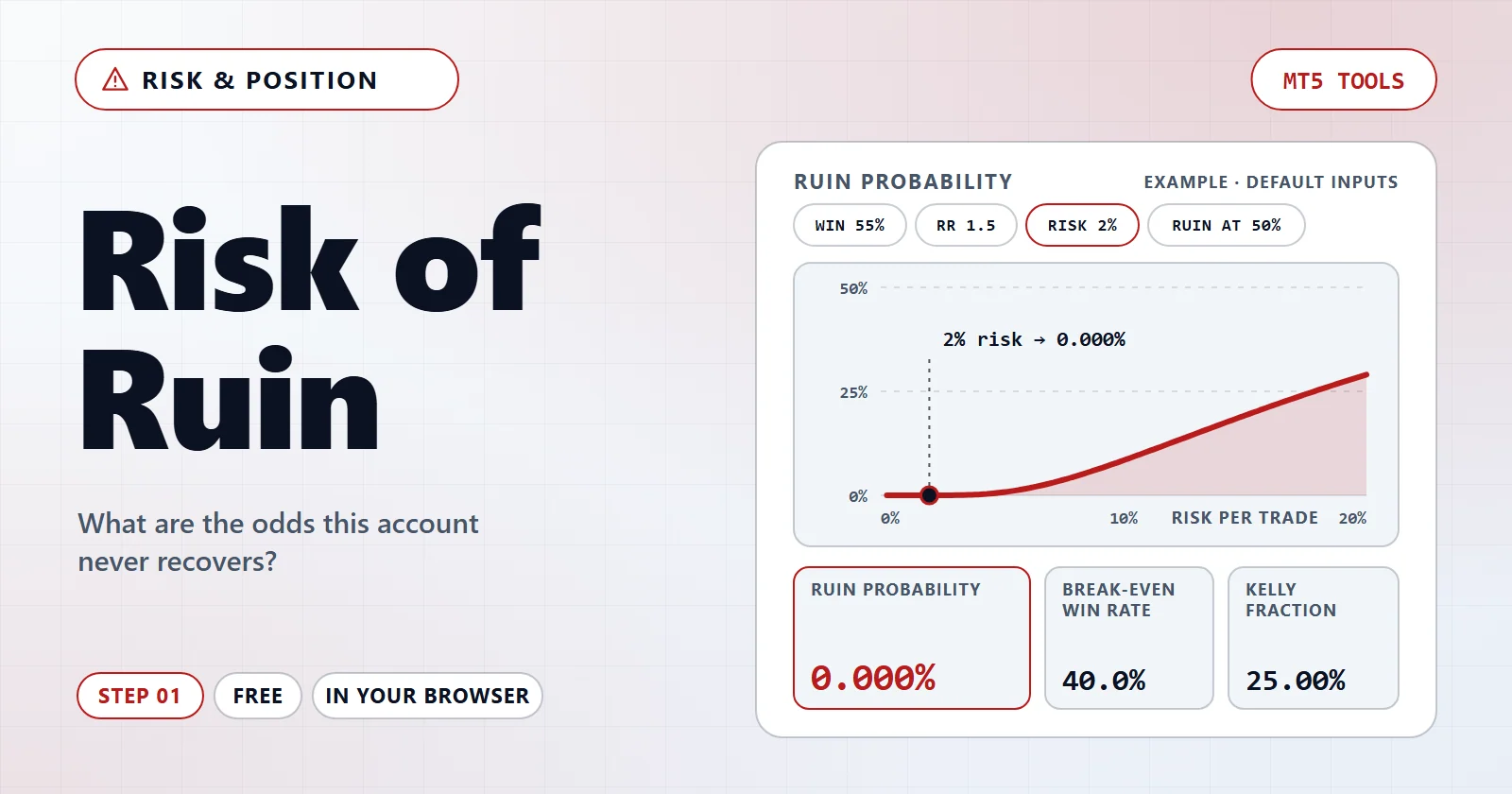
How likely is it that this account never comes back?
Position size decides what one loss costs. Risk of ruin decides whether a run of them ends the account. Both answers come from the same three numbers: your win rate, your reward-to-risk, and how much you stake per trade.
Free · No install · Runs in your browser
Diagnosis
The probability alone does not tell you what to change. These checks compare it against your own limit, against Kelly, and against how thin the edge is to begin with.
Chance of ruin at different risk per trade
- Chance of ruin
- Your target
- Your current input
What each risk level costs you
Ruin probability does not fall in proportion to risk. Halving the stake doubles the number of losses you can absorb, and the odds fall by roughly that power — which is why the bottom of this table looks so different from the top.
| Risk per trade | Losses to ruin | Probability of ruin | Use |
|---|---|---|---|
| — | — | ||
| — | — | ||
| — | — | ||
| — | — | ||
| — | — | ||
| — | — | ||
| — | — | ||
| — | — |
Simulated, not only solved
The number above comes from a formula. This section replays the same bet thousands of times and counts how often the account dies, so the formula has something independent to agree with.
Simulation result
Why the two numbers differ
Staking a fixed amount and staking a percent of the balance are different bets, and over a long horizon the percentage version is the more dangerous one. A fixed stake shrinks relative to a growing account, so its ruin odds level off. A percentage stake never shrinks in relative terms, so the odds keep climbing the longer you run. The formula models the fixed version; your EA almost certainly does the other one.
How to use it
- Enter your numbersType your own values into the fields, or choose your MetaTrader report if the tool reads a file. The values already there are only a starting example.
- Read the result and the diagnosisThe large number answers the question. The cards under it say what looks wrong and what to change.
- Try a fix or take it furtherApply a suggested change to see the result move, follow the link to the next tool, or copy the link to come back to the same inputs.
How this is calculated
The model is the classic one: each trade either wins the reward/risk multiple or loses one unit of risk, and ruin is reached when losses add up to the level you defined. Solving it gives the probability that the account never recovers — not the probability that it has a bad month.
Kelly answers a different question: what stake grows the account fastest. It is a ceiling, not a target. Betting above full Kelly makes returns worse and swings larger at the same time, which is the one trade nobody wants. Half Kelly gives up a little growth for a much smaller drawdown, and that is where most systematic traders sit — especially when the win rate came from a backtest rather than a live record.
The simulation is not decoration. Two implementations of the same model should agree, and when they do not, one of them is wrong. Ours are within a point or two of each other in the range where ruin actually happens; where ruin is very rare, the simulation runs out of samples before the formula runs out of precision, and the formula is the one to trust.
Questions and answers
Is it free, and do I need an account?
Free · No install · Runs in your browser. No account needed to calculate.
Is anything uploaded?
Nothing is uploaded. Every number on this page is computed in your browser, and the link you copy carries only the values you typed.
How far can I trust the result?
Win rate and reward/risk are estimates. Treat the output as the shape of the risk, not a forecast — a strategy that stops working turns any of these numbers into fiction.
Related tools
Keep exploring
Terms behind this tool
- MartingaleA position-sizing rule that multiplies the lot after each loss, usually by two, so that one win repays the whole losing run plus the original target. In an MT5 EA it shows up as a lot-multiplier input and as volume that rises after losing deals.
- Negative balance protectionNegative balance protection is a broker policy that resets a trading account to zero when losses take it below zero, so a client cannot lose more than the account holds. It follows the entity and account type, not the brand.
- Win rateThe percentage of trades that close at a profit, calculated as winning trades divided by total closed trades. Must be evaluated alongside risk/reward ratio to be meaningful.
- Worst losing streakThe longest consecutive series of losing trades or the largest cumulative loss within a contiguous run of losing trades in a backtest or live record.
Build an EA around the risk you chose
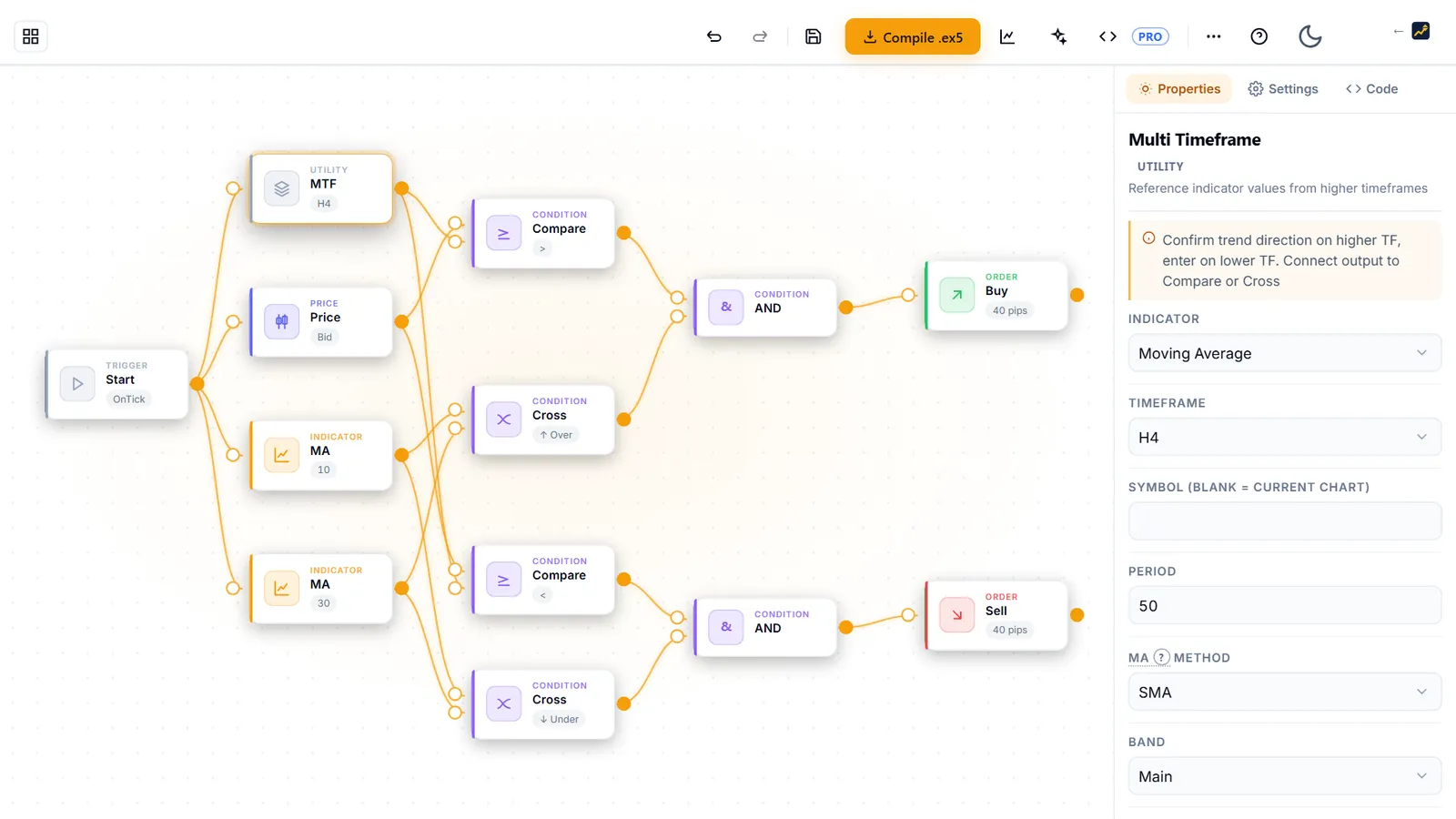
Win rate, payoff and risk per trade are the inputs this page uses, and an EA needs the same inputs. AIStrategyMiner Builder lets you wire your entry and exit rules together as blocks and set the risk per trade, with no code.
- Set the risk per trade to the value you tested here, then compile a standard .ex5 file for MetaTrader 5.
Check the finished EA in MetaTrader 5 before you trust it. The numbers on this page come from what you typed; they are not a forecast of results.