Moving the target after entry
Extending a target because a trade is going well rewrites the ratio you took the trade on. The honest risk/reward is the one that existed when the position opened.
also: TP, profit target, target
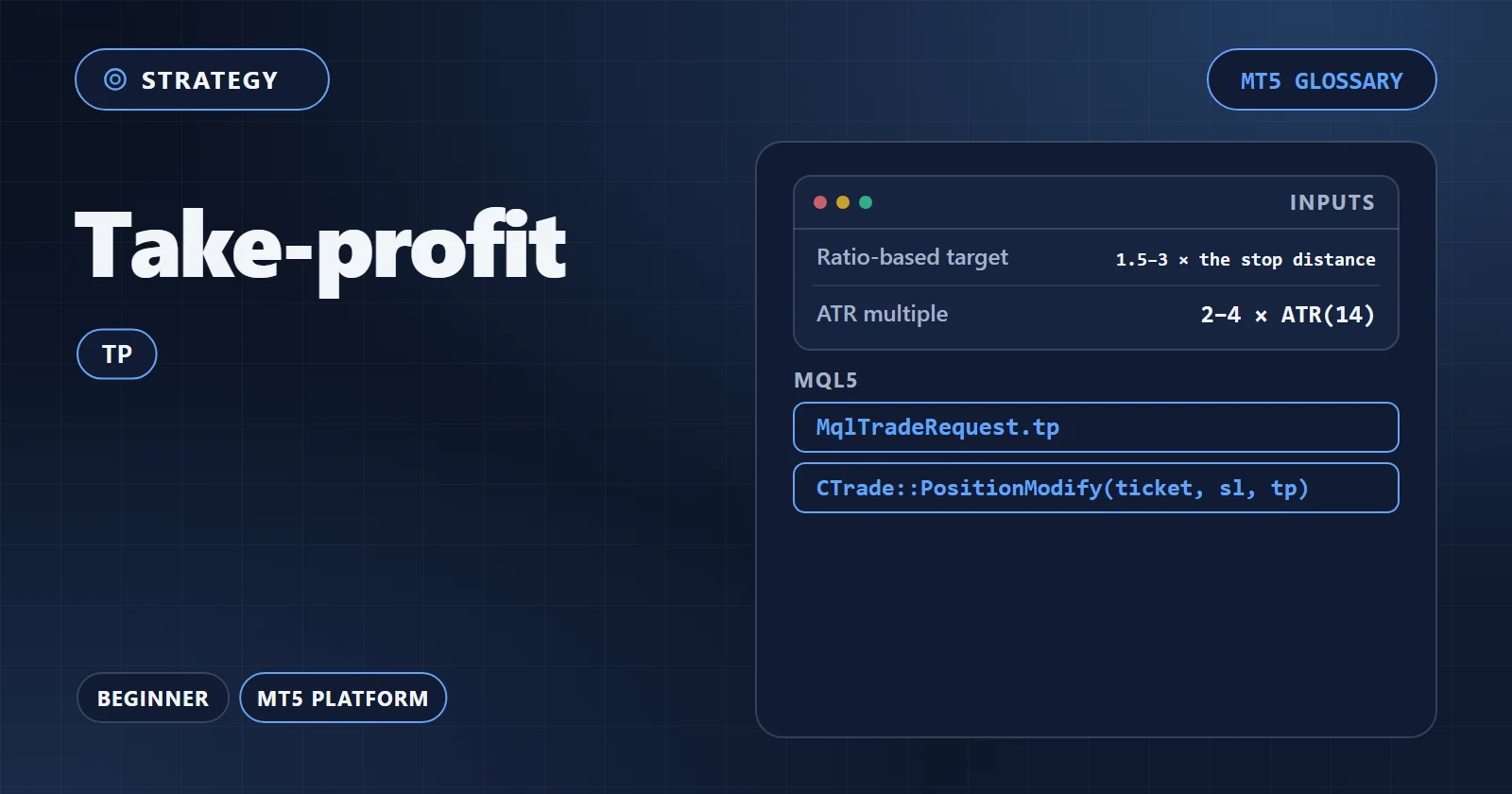
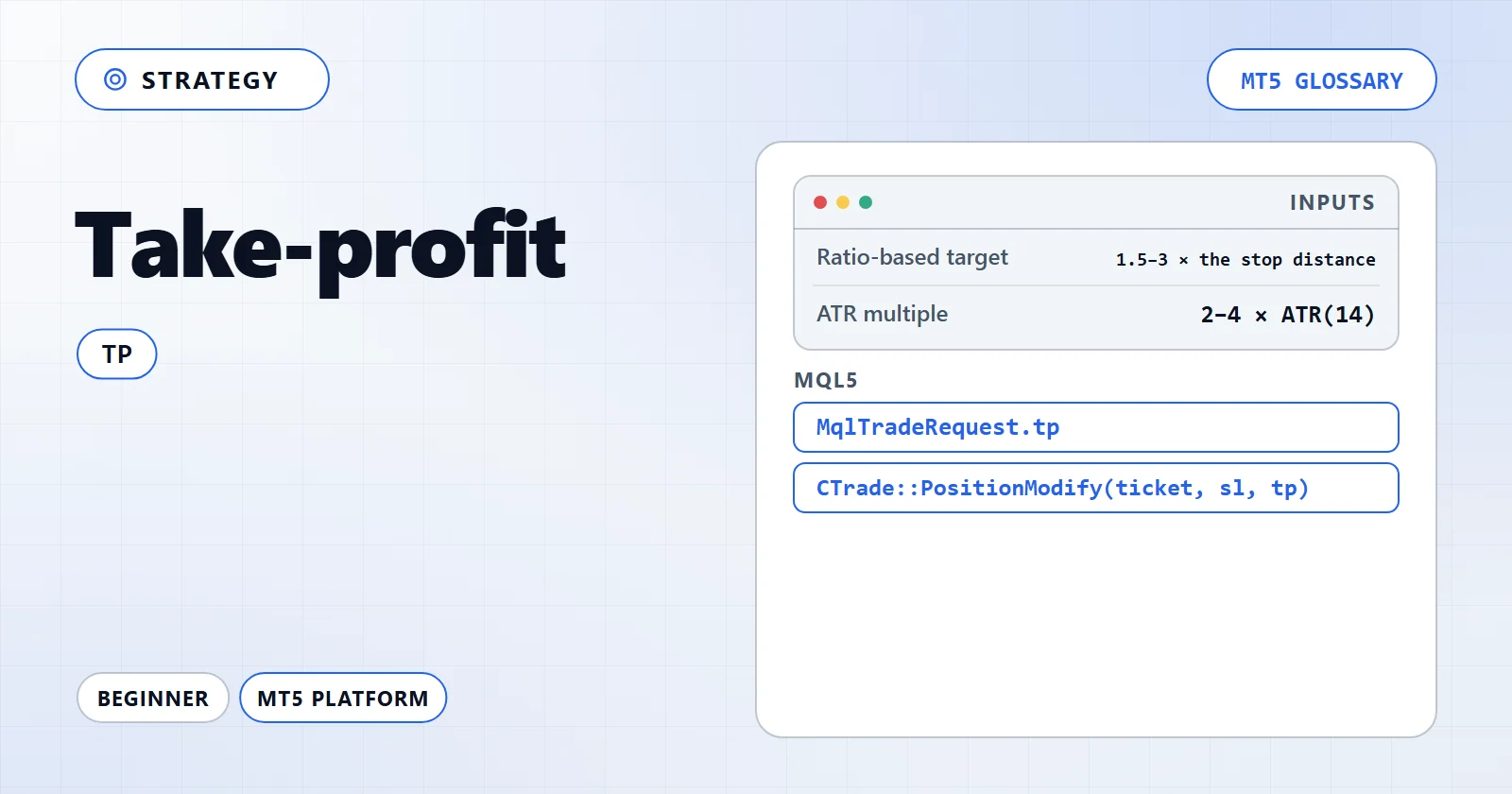
A take-profit is a price level attached to a position at which the broker closes it automatically to bank a gain. It lives on the broker's server like the stop-loss, and the trader decides it before the trade opens.
The price at which the trade has been right enough. The stop says how wrong you will let it be; the target says how right is enough.
The target is where a strategy collects its edge, and the number traders move most often after the fact. Fixed at entry, it turns the risk/reward ratio into a claim you can test.
| Setting | Typical value | Note |
|---|---|---|
| Ratio-based target | 1.5–3 × the stop distance | The most common EA formulation; the shipped median here is exactly 1.5. |
| Shipped target, 18 uniform-target EAs here | 25–300 pips, median 107 | What these builds send. Three ship a target narrower than their stop — 100 against 114. |
| ATR multiple | 2–4 × ATR(14) | None of the 17 ATR-named inputs in this catalogue controls a target; all of them gate an entry. |
One entry rule, two target distances, two very different hit rates to clear.
Target A wins far more often and hands most of it back in costs and in losses the size of the wins. They are not the same product.
Calculation 1 ÷ (1 + 1) = 50% · 1 ÷ (1 + 3) = 25%
Result Two products from one entry rule
Read the target beside the stop and beside the realised results. What the EA achieved says more than what it aimed for.
| Range | What it means |
|---|---|
| Average win well below the configured target | Something else closes the trade first. On the 11 records here that declare another exit, the median win runs from 0.5% to 45% of the target. |
| Average win close to the target | The target does what it says. On the 7 target-or-stop-only records, 96.43% to 100% of winners closed within 2% of it. |
| Target within a few times the spread | Costs take a large share of every win; the strategy needs an exceptional hit rate to survive them. |
| No target, exit by trailing stop only | Legitimate for trend strategies, but the risk/reward has to come from realised trades, not a declaration. |
Every EA here publishes its exit rule and its trade ledger; the figures on this page come from those backtest ledgers (EXP-TARGET-REACH-001).
Extending a target because a trade is going well rewrites the ratio you took the trade on. The honest risk/reward is the one that existed when the position opened.
A long closes at the bid and a short at the ask. A target placed exactly on a round level can sit unfilled while the chart, which draws the bid, appears to have touched it.
On the 7 builds here where the target closes 96–100% of winners, the money ratio still landed below the declared ratio on 6 of 7, lowest 0.90×. Spread, commission and swap take that much; a trail or a break-even move takes far more.
Every listing ships its closed-trade list, so each winning exit sits beside its target. Eighteen of the 31 records send one target distance on every order.
| 18 uniform-target records, 3,965 winning trades | Figure |
|---|---|
| Winners closing within ±2% of the shipped target | 42.02% (1,666) |
| Winners closing short of it | 56.77% (2,251) |
| Winners closing past it | 1.21% (48) |
| 7 records with no trail, no timed close, no break-even move | 97.87% at target, lowest 96.43% |
| 11 records that declare one of those | 25.85% at target |
| Declared ratio, target ÷ stop | 0.88–4.19, median 1.5 |
| Money ratio below the declared ratio | 15 of 18 |
Rows four and five split row one. Three trailing builds ship a 100-pip target behind a 114-pip stop and a 34-pip trail; the trail closes 83–86% of their winners at a median 21–24 pips, and their money ratio lands at 0.32–0.36 against a declared 0.88. Four break-even builds post a median win of exactly 1 pip. Row three is the favourable side of the fill: a gap through the level fills at the next price, the largest 112.6 pips against a 67-pip setting.
On a build that declares a trailing stop or a break-even move, treat the target as a ceiling and read the realised average win from the ledger. Pair it with the stop-loss that sets the other half of the risk/reward ratio, weigh it against a trailing stop when the strategy has no natural level, and read the exit rule each expert advisor states in the catalogue.